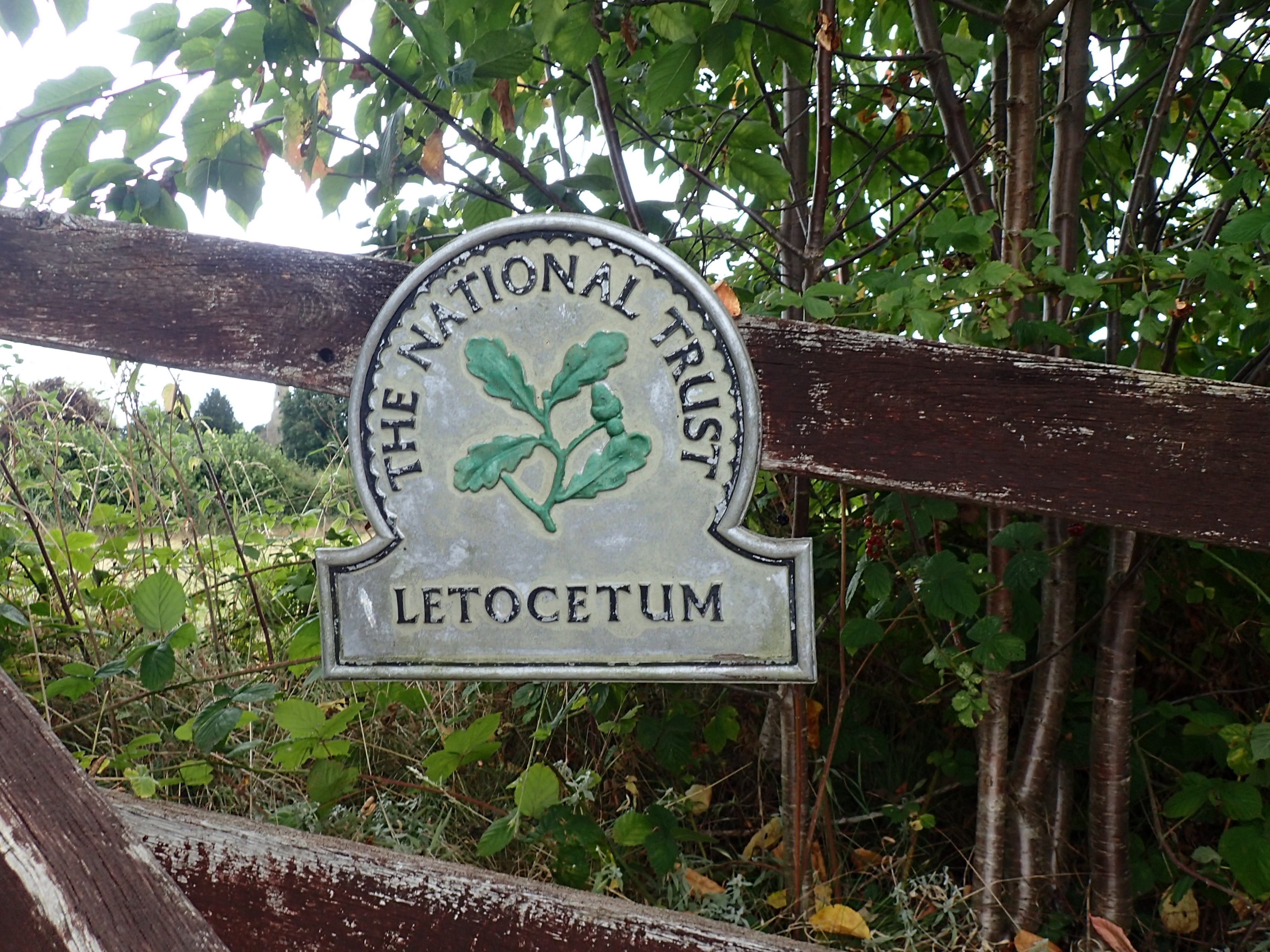
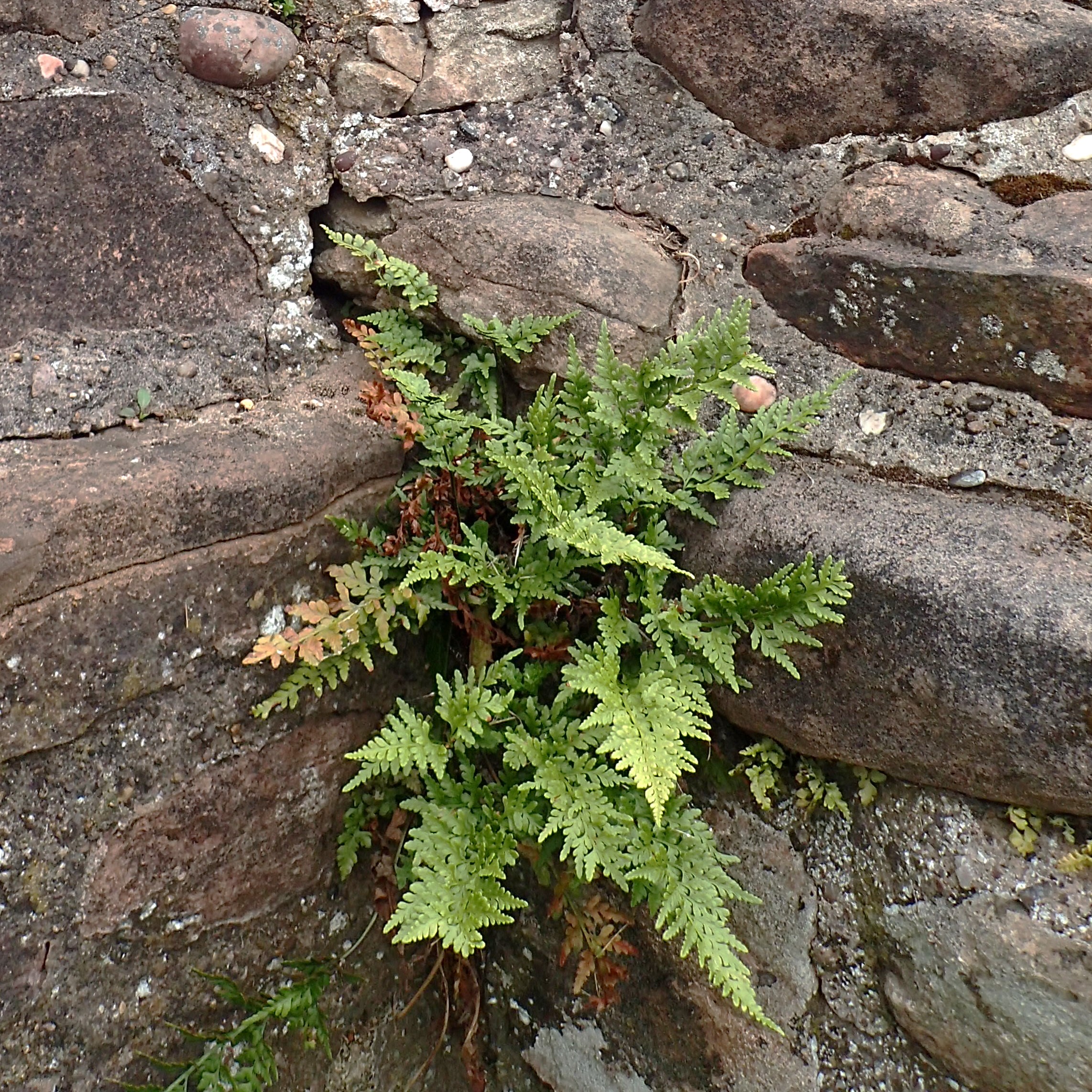
Black Spleenwort and Wall, Staffordshire

There are several places called Wall, one is near Newcastle and that is obviously associated with Hadrian’s Wall another is in Staffordshire, and this one is on the famous Watling street a lot of which is now the A5.

The site has several plants growing on the walls, but when I visited in July many had succumbed to the hot dry summer, not so the Black Spleenwort which presumably has quite extensive roots as it is a perennial and has therefore the time to get its roots well into the wall and down to any residual moisture.

This fern is quite variable and depending on where it is growing it can look quite different. It is often to be found growing from walls, particularly in the west of Britain, in open situations the fronds are quite compact and the individual leaflets are rounded and the colour is light green. In woodlands it is more rangey and the individual leaflets are pointed and jaggy edged also they are usually dark green. One characteristic which does help to identify it wherever it is growing is that the central stalk down each frond has two groves running along it.

I had not heard of this place until I mentioned to my son that I was trying to put together something about Walls and Flowers and he said there is a village just along from where his brewery Trinity Brew Company is located on the outskirts of Litchfield. He said it was named Wall because there is a bit of Roman Wall there. Well not just ‘a bit’ but quite a lot.

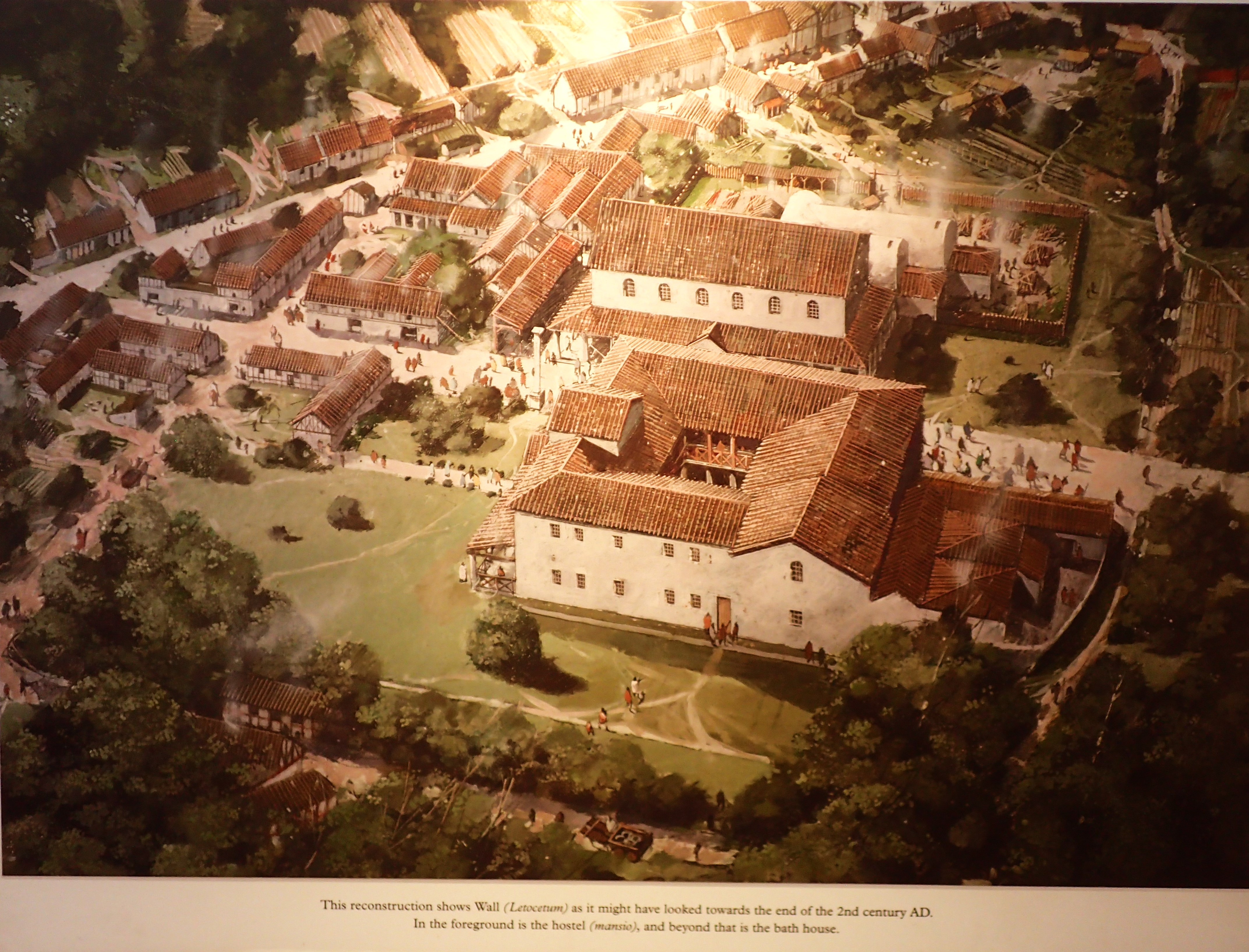
Wall is however its new name, originally it was called Letocetum by the Romans who developed it as a fort on Watling Street, in fact there was probably habitation there before the Romans came as it is a junction where two ancient pathways cross Watling Street and Ryknild Street now known as Iknield Way . Also it was on a boundary between two Celtic tribes the Cornovii to the West and the Corieltauvi to the East. The original Iron age name was Lētocaiton meaning Grey Wood ( caiton has become modern day Welsh Coed ie wood).

Possibly the Letocetum referred more to the area rather than the specific location of a village as subsequent to the fall of the Roman empire the village disappeared and was replaced by another site nearby which became Litchfield a name also derived from Letocetum.

What you see now is the remains of two buildings, a guest house and a bath house. As is often the case with Roman settlements there were several reconstructions and alterations over the course of the 367 years they were here. Originally they just built marching camps as they proceeded north west along the ancient route of Watling Street, later they improved the route putting in a stone base so that communication could rapidly pass through and the the first guest house was built around 80AD but this was wooden, the first Bath house followed in 100AD but what you see now represents much later constructions made with stone and dating to the second and third centuries AD. However at its height it would have been quite a populous bustling community probably producing leather goods, glassware, pottery and metalware.

Other species growing at Wall were Mouse-eared Chickweed, Maidenhair Spleenwort, and Selfheal, but the Black Spleenwort was perhaps the commonest certainly the most impressive.

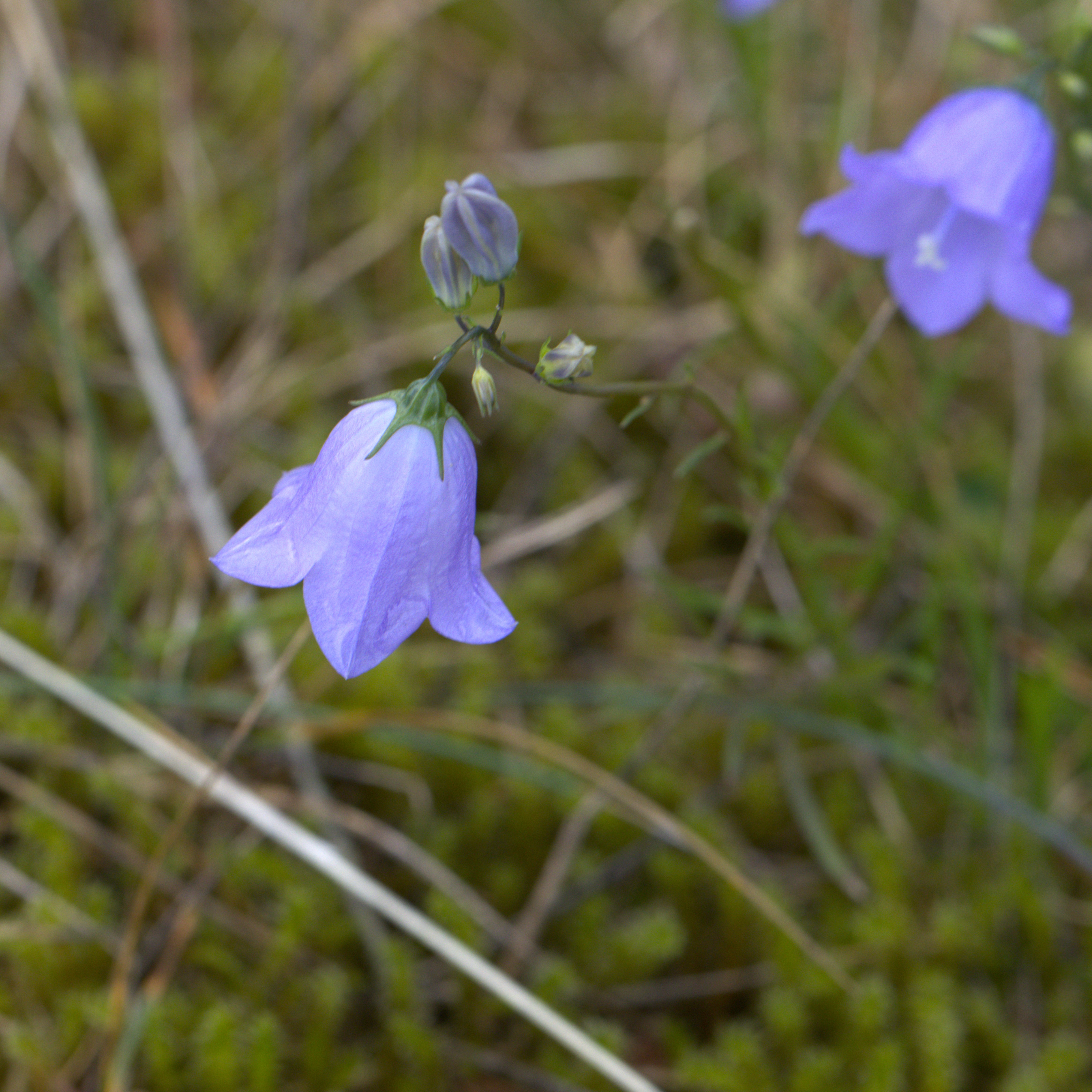
Harebell and Milecastle 37, Hadrian’s Wall

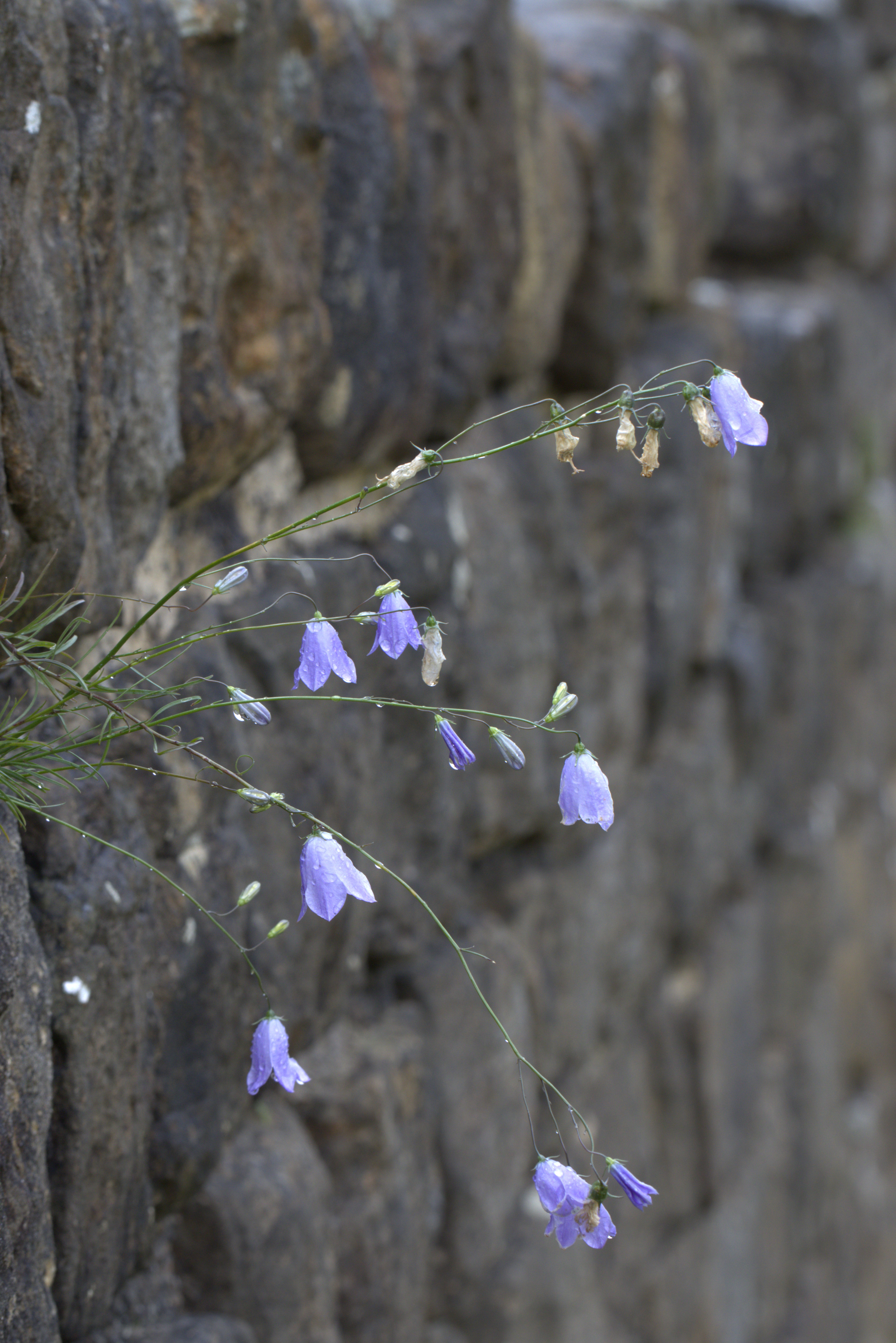
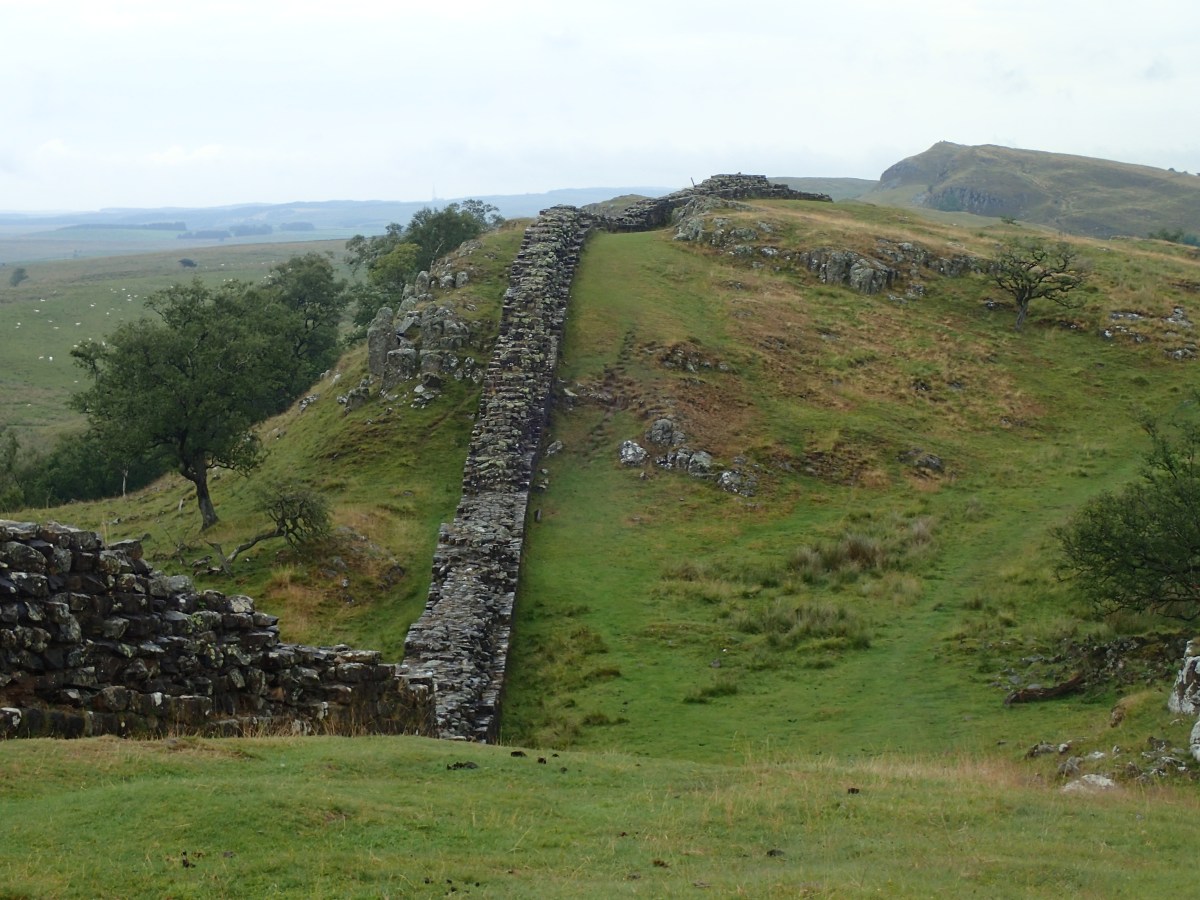
During a recent visit ‘up north’ as a southerner would say, we visited several places along the Hadrian’s Wall and I encountered Harebell numerous times. It was of course growing across the region in the low grassy moorland, but it was also growing directly out of or on top of the wall.

This beautiful and delicate looking little species is a rhizomatous perennial herb. It is however far from delicate in its requirements, being quite tolerant of dry, open, and infertile habitats. It is also not too fussy about soil pH being found in both mildly acidic and alkaline soils also it can tolerate some heavy metal presence. All in all it is well suited to life on walls but is also encountered in grassland, fixed dunes, rock ledges, roadsides and railway banks. It flowers from mid summer onwards.

Its scientific name is Campanula rotundifolia and it has several common names as you might expect, one is Scottish Bluebell but in Scotland they often call it simply Bluebell. It is not related to what the English think of as a Bluebell the one that grows in woodlands. It is the flower emblem of Sweden and the county flower of Yorkshire.

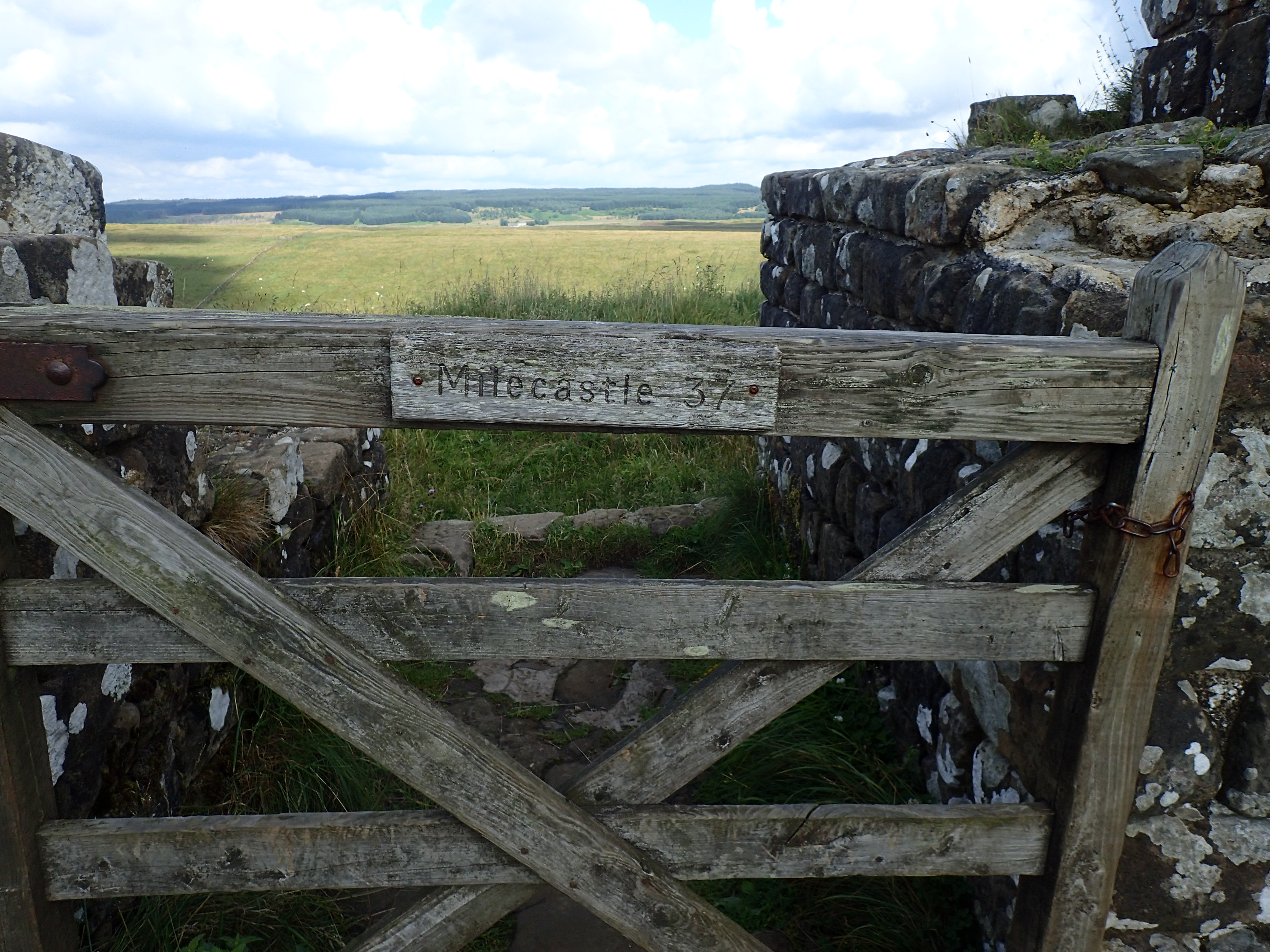
One of the places we saw it on Hadrian’s wall was mile fort number 37. it is the next fort along from Housesteads. Not surprisingly these milecastles (small forts) were built at one mile intervals all the way across the length of the wall.

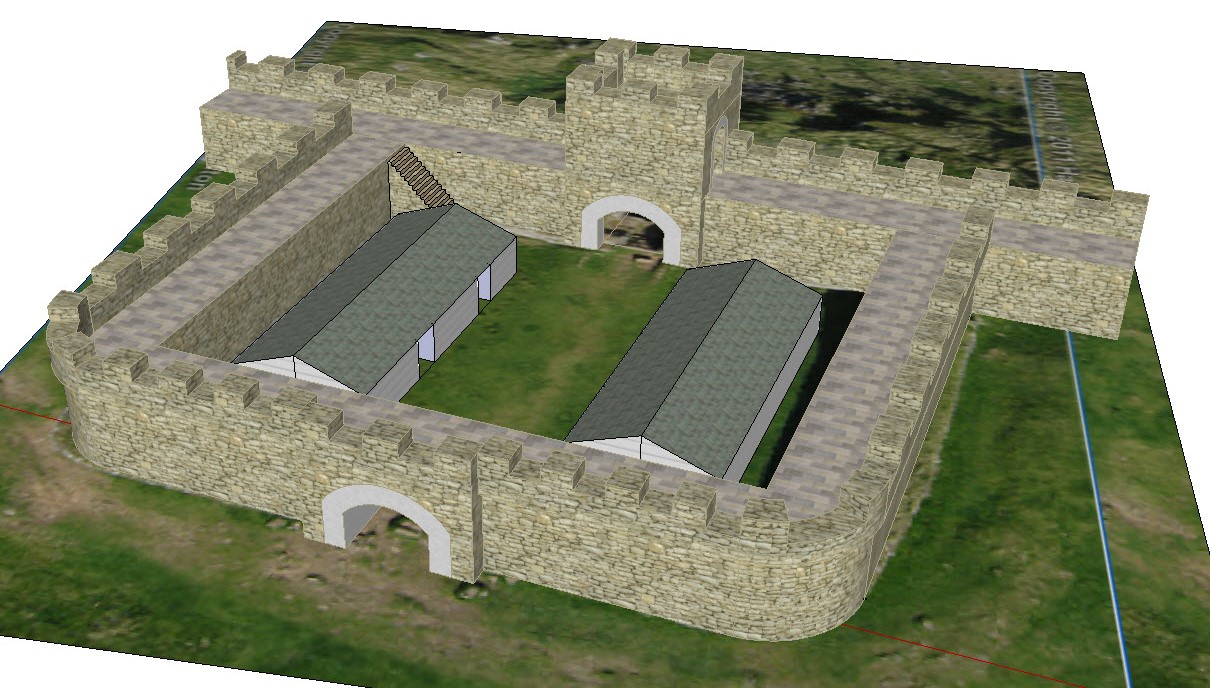
This artists impression of how Milecastle 37 would have looked is by courtesy of HUKBMBEAR Thank you.

When it was up and running it would have had housing for 20 to 30 soldiers and they would have remained on site also each garrison would have manned the neighboring turrets. The milecastle’s garrison was a border post as well as being defensive in time of rebellion. It would have allowed the passage of people, goods and livestock across the frontier, and it is likely that the milecastle acted as a customs post to levy taxation on that traffic. Could Scottish independence could see the reintroduction of modern day equivalents?

Between each milecastle there would have been two turret structures these were located approximately one-third and two-thirds of the way between the milecastles; all very neat and precise just like the Roman roads.

The two turrets linked to milecastle 37 are named 37a and 37b. 37a is at Rapishaw Gap and was probably demolished before the Romans abandoned the wall and the only evidence for it now is some earthworks which can only be appreciated from aerial photographs.

Turret 37 b at Hotbank Grag is still visible but it is just a stone studded earthen platform so not that impressive now.

 There were 80 milecastles and 158 turrets.

Hart’s-tongue Fern and Hadrian’s Wall

I finally got to visit Hadrian’s Wall about 50 years after I purchased the Ordnance Survey map of the area, back then it cost me 55p and in the bottom corner it has Crown Copyright, 1964. I suspect that I purchased it around 1973, at that time I was quite into ancient history. Apart from reading quite a lot of history books I remember visiting Stonehenge, back then it was free and you could walk right up to it and touch the stones, not so now.

We spent two days at various sites along the wall, working our way from East to West. The scenery is quite magnificent and there are lots of places where you can see the wall stretched out across the countryside and I suspect a Roman legionnaire would still recognise the scene if he could be magicked back into exitance today. The region near Walton Ridge was quite evocative and one of the plants growing there was the Harebell which is the subject of another chapter.

We came across the Hart’s-tongue fern at Vinolanda, and it was the only place where I saw it and even there I only spotted a couple of specimens. Vinolanda is a Roman auxiliary or supply fort about half way along the course of the wall. When the wall was built it had look out turrets every mile, then every so often there were large garrison forts set just back back from the wall, there were also forward forts these were located a little distance Infront of the wall and then supply forts located some distance behind the wall.. At its height there would have been about 10,000 soldiers distributed along the 73 mile wall and add to that there would have been large numbers of civilians, traders and entertainers and all the support folk that a large body of men would have attracted! If you take my meaning.

During the course of the Roman occupation the construction of the forts changed and older buildings were abandoned and new ones constructed. An example is that at Vindolanda there are two bath houses an earlier one constructed around 103 to 105 AD and a later one dating to the 3rd or 4th century AD. This bath house is located outside the main fort as were numerous other buildings housing the extensive community associated with the military camp. The bath would have been used by both soldiers and civilians but probably at different times. The reason it was outside the main fort was because of the risk of fire. Bath houses were heated by furnaces and hot air was ducted underneath raised floors called a hypocaust, this floor is about 80cm above the ground, the space underneath is now providing a home for the fern, I doubt much would have survived there when hot air was being circulated. The floors themselves got quite hot and bathers would wear thick wooden clogs to prevent burning their feet.

Apart from all the stone remains there is a superb museum at Vinolanda with some amazing finds that aerologists have recovered from the site. The shoe and sandal collection is the first thing you see as you enter, the coins, jewellery and glass wear is stunning but perhaps the most amazing finds are small wooden tablets with writing on, lots of them, and they have been translated and they are what folks back then were saying to one another it is the emails of the time.

I cant resist giving you a flavour of what they cover this one, randomly selected, (there are hundreds of them) was translated as saying.

bruised beans, two modii, chickens, twenty, a hundred apples, if you can find nice ones, a hundred or two hundred eggs, if they are for sale there at a fair price. … 8 sextarii of fish-sauce … a modius of olives … (Back) To … slave (?) of Verecundus.”

A shopping list! and they cover a vast range of subjects anything that one person might write to someone else.

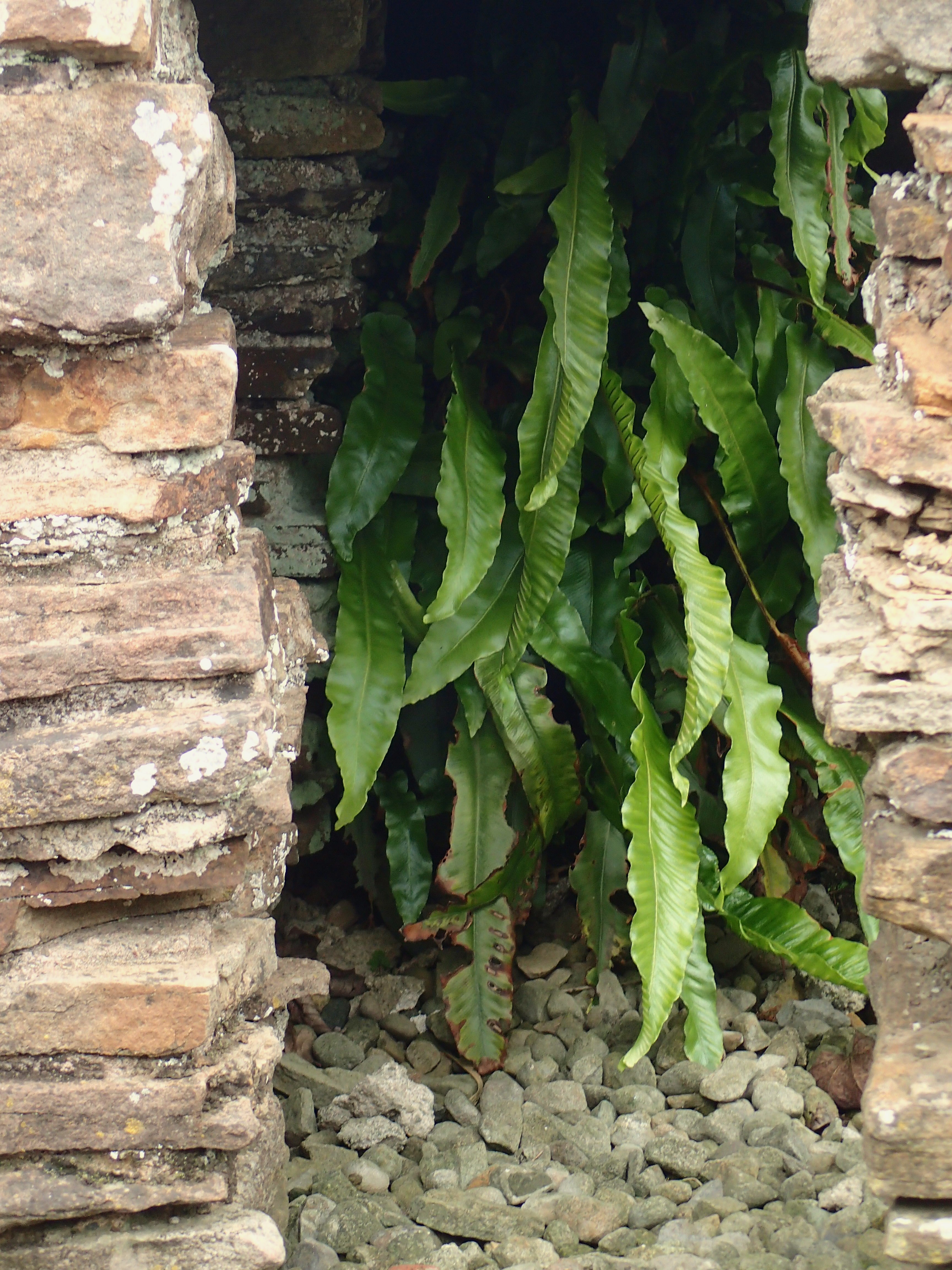
I could go on about the museum and all its contents for much longer but lets switch now to the Hart’s-tongue fern which here was sheltered and protected by growing in the wall of the old underfloor heating. Protected not only from the elements but possibly also from the herbicide sprays that are no doubt occasionally used to keep the walls reasonably weed free. Hart’s-tongue fern is one of the few or only British ferns which has an entire leaf, ie not divided into lots of smaller leaves and leaflets, the typical compound leaf that ferns and some higher plants like Cow Parsley have. The Adders tongue fern has a small rolled up leaf somewhat similar to the spathe on a Lords and Ladies plant so that is the only other British fern with an entire leaf. On the undersides are the distinctive spore producing areas (sori) which turn brown as the spores are produced. This species retains its leaves during the winter but then produces a new batch in the Spring and the old ones gradually die off over the summer.

The scientific name is Asplenium scolopendrium but it is also called Phyllitis scolopendrium. The BSBI (Botanical society of Britain and Ireland) call it Phyllitis so that’s the one I would go for. It is found all over the UK and Ireland and often grows from walls or rocky outcrops, its only restriction on distribution is that it does not like acidic conditions. The species name ‘scolopendriun’ derives from the arrangement of millipedes or centipedes feet as the pattern of the sori on the underside resembles these species.

Snapdragon; Hexham Abbey, Northumberland

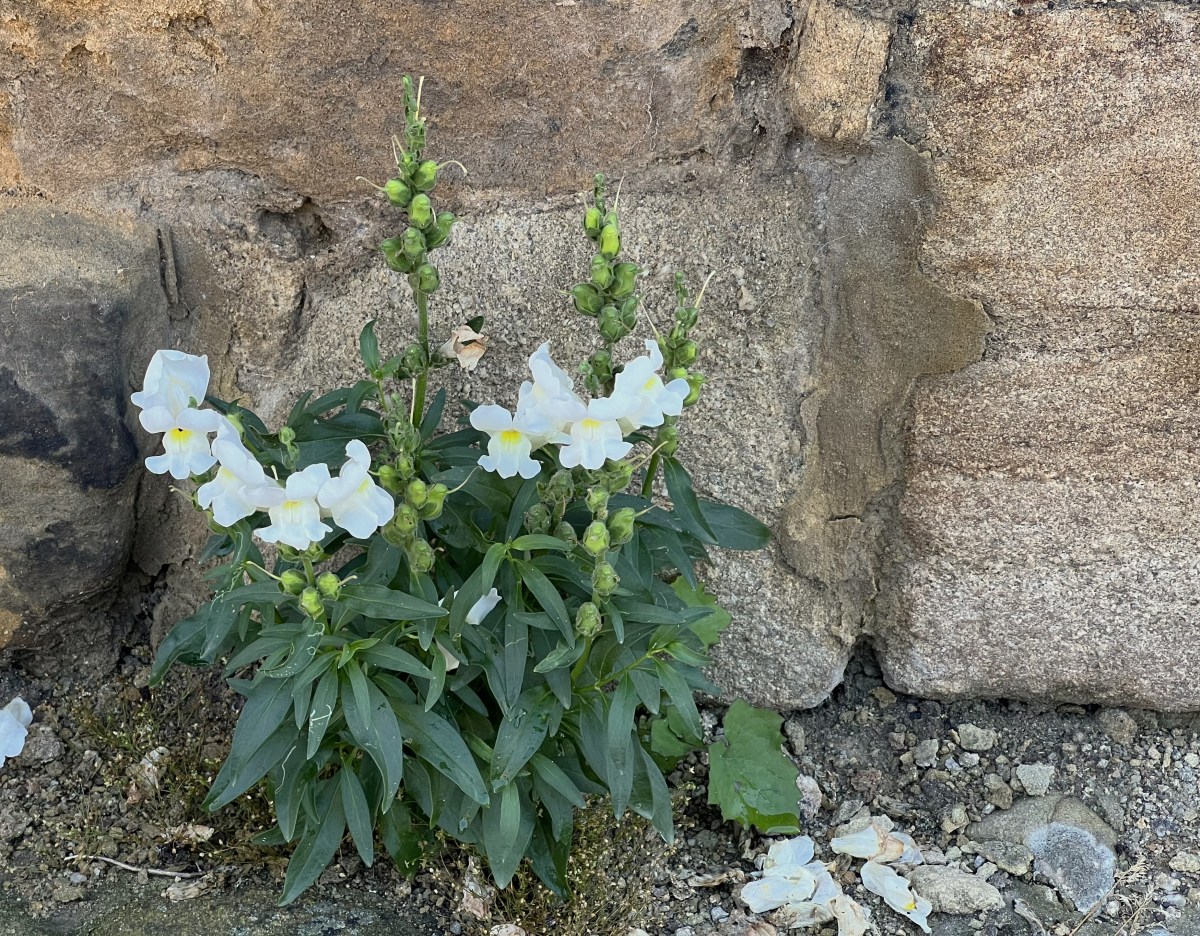
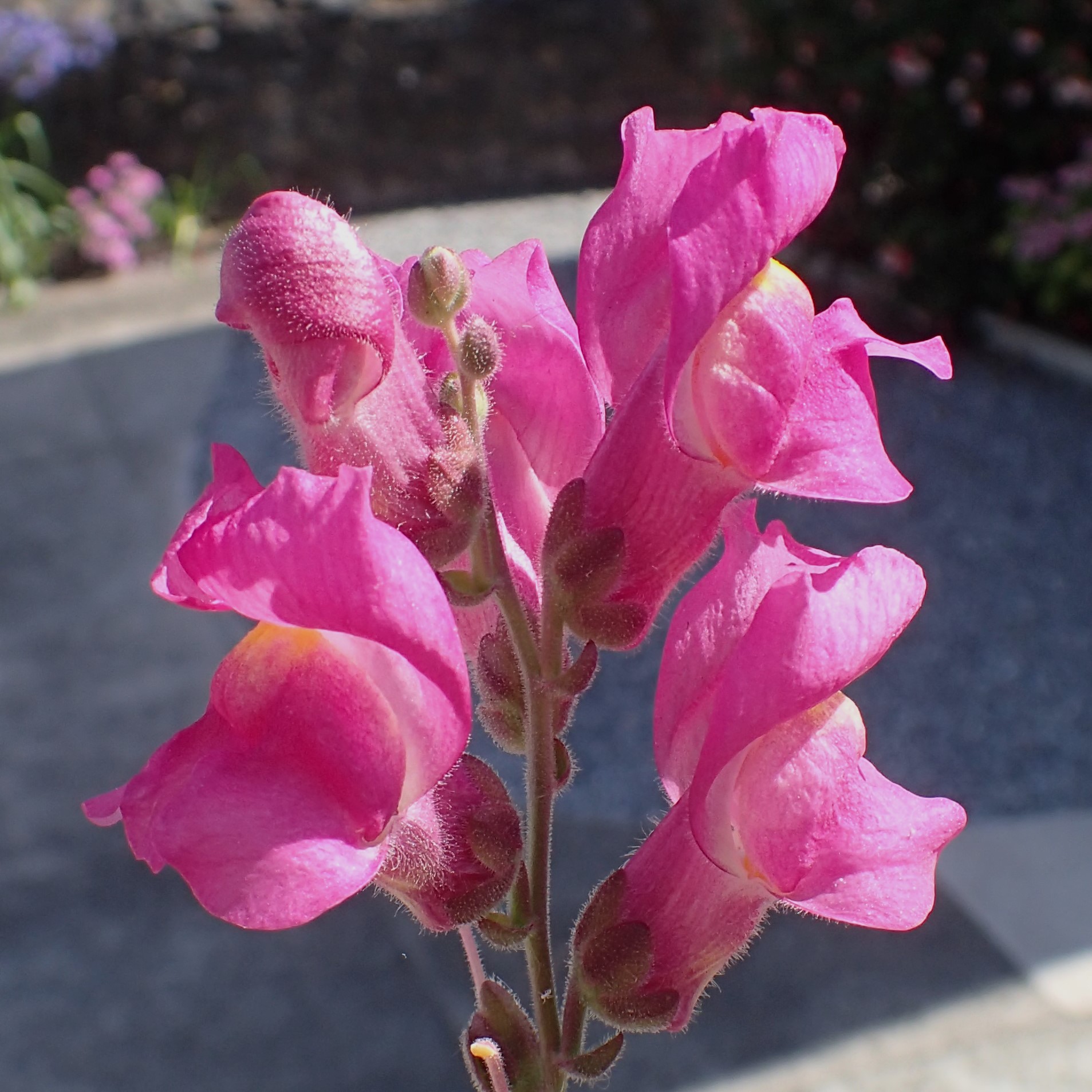
Snapdragon or Antirrhinum is a garden plant which has long been established in the wild. It is not native being from the Mediterranean and SW Europe. It was first grown here in gardens during Elizabethan times. It has a striking flower which is usually in a rich pink colour although garden varieties can come in various shades, white, cream, yellow and all stations from pink through to purple. The flower is perhaps reminiscent of a dragon and it does snap shut with the upper and lower parts coming together quite strongly. The only pollinators that can force their way into the flower is the larger bumble bees. I remember as a small boy being fascinated by the bumble bees pushing their way into the flowers and then backing out covered in pollen, also along with many other children I would pull one of the flowers away from the flower head and then you could squeeze the sides and the mouth would open.

It is an annual or short-lived perennial herb and is widely naturalised on old walls, waysides, pavement cracks, waste ground and rubbish tips. Populations can be long-lived, and the species reproduces readily from seed. It is less common in the North and in Scotland so Hexham is towards its upper limit. It is usually found close to habitation. It is quite tolerant of dry conditions, it prefers a pH of 7 and is not that frost hardy, thus its preference for southern Britain.

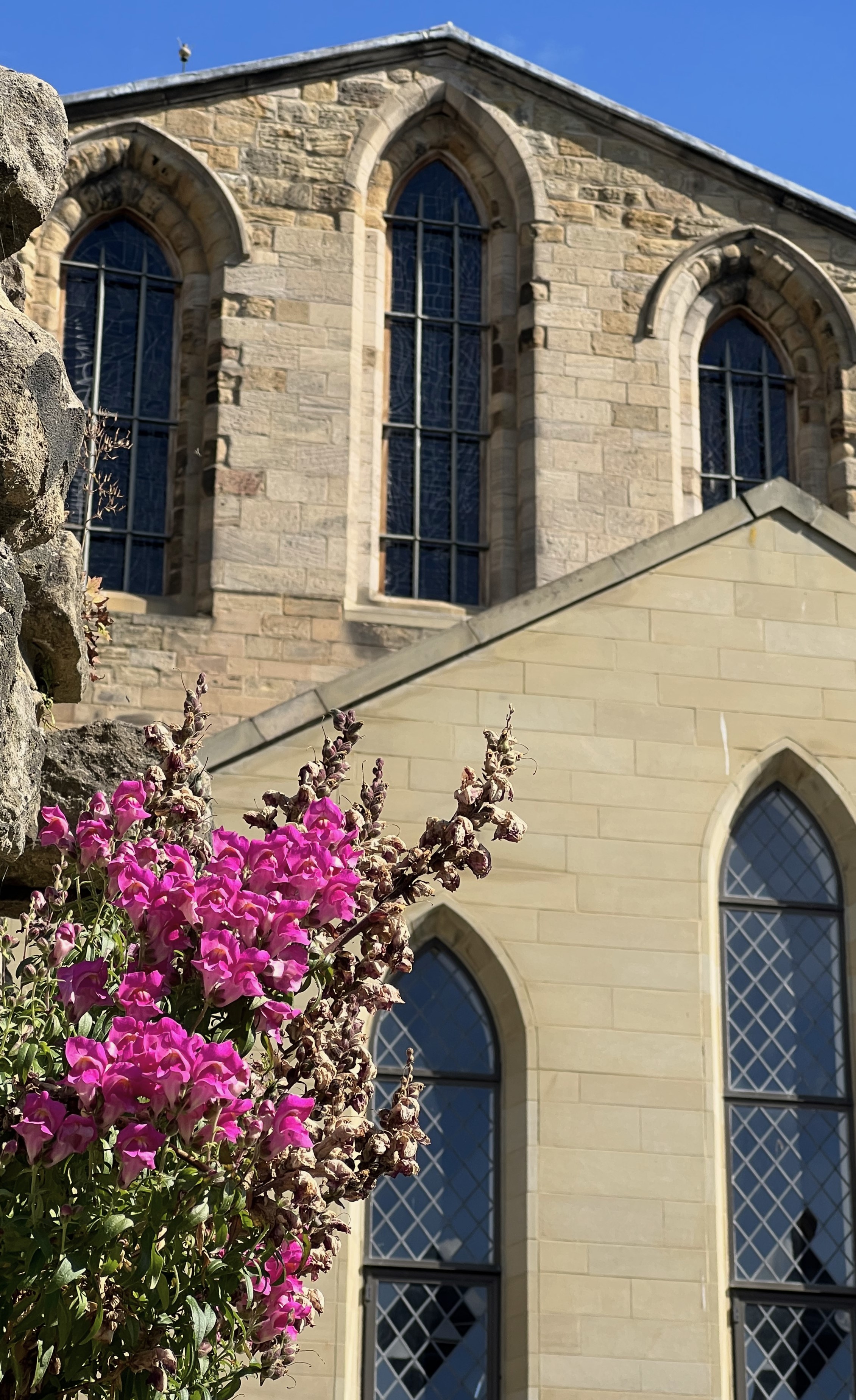
Hexham Abbey was built between 674 and 678, and much of the stone came from the remains of Roman buildings in Corbridge which is three miles away. It was Queen Etheldreda who gave the land to Wilfrid Bishop of York in 673 or 4 and thus it is one of the earliest Christian sites in the UK. What you see today is not what was built back then, it was largely replaced in the 12th and 13th century between 1170 through to 1250. Subsequent additions have been made, but given that every phase of building has been done in the same light honey coloured stone, it helps give the whole building a unity of form.

What does remain of the original church is the crypt and there you can see many roman stones including one that has the names of three emperors engraved into it Septimus Severus ( 193 to 211AD ) and his sons Marcus Aurelius ( 198 to 217 AD) and Geta. The three ruled as a triumvirate after Severus appointed his sons as joint rulers in 198 but when Severus died in 211 then the two sons ruled together but not that harmoniously.

Today the Abbey is well worth a visit, located in the very centre of Hexham and it does have a pleasant court yard with surrounding gardens and an excellent tea room. I was visiting the area with Dr Colin Harwood and thanks have to go to him for the photographs. He obliged by taking the pictures as I had left my camera back at base. As you can see both pink and white varieties grow on the walls.

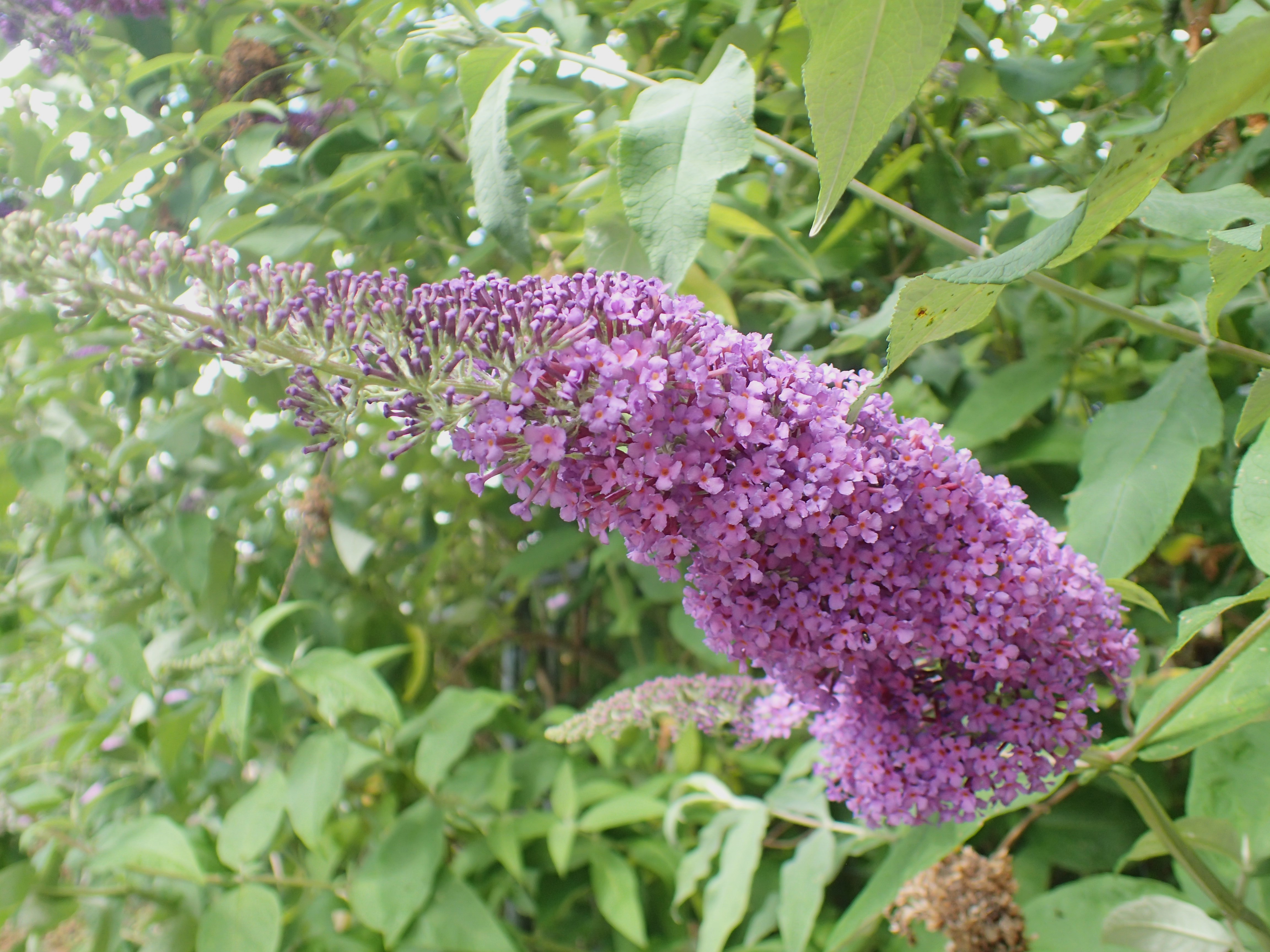
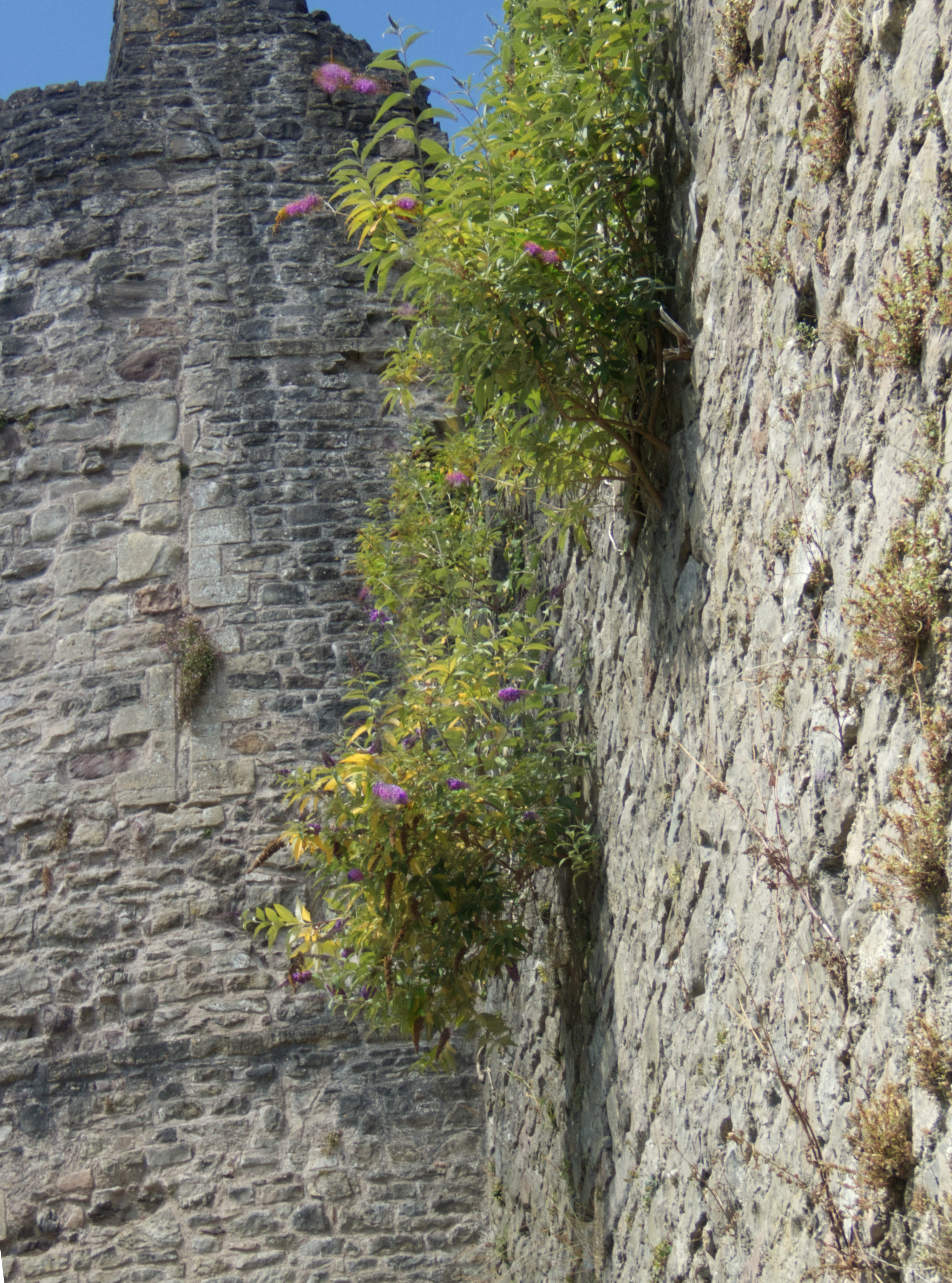
Buddleia and Chepstow Castle

I was unsure whether to include Buddleia as a wall flower partly because it is a shrub and partly because I was uncertain as to how often it grows out of walls. However as I have visited more and more walls I became satisfied that it qualifies as it is quite commonly found in walls. As for it being a shrub, I have noted that in many walls it is quite small and struggling and rarely reaches the size that it can do when growing directly from the ground. This may be because whoever is looking after the wall perceives that it could be causing substantial damage and removes it so that it never gets that big whereas a little bit of Rockcress or Ivy-leaved Toadflax just goes unnoticed. Consequently although it is a shrub plants such as Valerian are the same size or even bigger than the Buddleia. I have also chosen to include Ivy and Wall Cotoneaster and they too are classified as shrubs.

Network Rail says buddleia has a habit of growing in walls where it can interfere with overhead power lines and obscure signals. Whilst it does not cause “serious” problems such as blocking train lines, it does have a habit of popping up in “annoying places” where removing it takes up valuable time and resource.

The company cuts down large buddleia before removing or killing the stumps, sprays small buddleia with herbicide, and uses weed-killing trains to keep the network clear, while staff use portable sprayers at stations.

One would think that the potential for nuisance might be outweighed by the benefits to wildlife, such as butterflies.

Buddleia was imported from China in the 1890s. There are over a hundred and forty different species of Buddleia in the world. Its scientific name is Buddleja davidii which is a nod to Pere Armand David a Catholic missionary who worked in China. He is more famous for the Pere David Deer which he rescued from the brink of extinction by bringing some back to Britain where their numbers increased and then some were successfully reintroduced back into China. He also is responsible for introducing over 50 different Rhododendron species into Britain which as it turns out was not such a good thing.

Buddleia is the common name and Buddleja is the scientific name because Linnaeus, who was responsible for naming many species ,wrote his ‘i’ with rather a long down stroke so that it looked like a ‘j’ which caused confusion. It could have been called Buddleja davjdjj!

Buddliea is now considered an invasive plant although I would not put it in the same category as Japanese Knotweed or Himalayan Balsam. It gets about by virtue of its winged seeds so it spreads along railway lines quite well. It is recommended that one removes the dead flower heads before the seeds form thus encouraging it to produce more flowers but preventing the spread of the seeds. This is the strategy I adopt with the few bushes that grow in my wood. The flowers are out from June to October, It can grow into quite a large bush maybe 5metres high but in walls it is normally limited. Certainly at Chepstow Castle it was not very large.

The castle though is quite impressive and has a good range of flowers in the walls as the maintenance is not over harsh. It is managed by Cadw. This is a Welsh word meaning ‘to keep’ or ‘to protect’ and that’s exactly what the organization does, working for an accessible and well-protected historic environment for Wales, so obviously the integrity of the walls is a priority but equally they are not over zealous in removing every fern and flower.

It did not take long after 1066 before the Normans set to work securing their new kingdom. Construction of Chepstow Castle was was started in 1067 by Earl William Fitz Osbern, close friend of William the Conqueror, making it one of the first Norman strongholds in Wales.

Later it was occupied and improved on by William Marshal (Earl of Pembroke). He was a very interesting character. He was originally just a small time knight but due to his jousting prowess he impressed Elanor of Aquitaine and subsequently her eldest son Henry II. As a consequence he acquired a French wife and the castle. On his deathbed Henry II asked William Marshal to take his cloak to Jerusalem, just a small trip but I suppose you did not argue with the monarch back then. On his return he was rewarded by Eleanor’s second son, Richard the Lionheart, who allowed him to marry the rich de Clare heiress Isabel. It was her family who had held Chepstow and other vast estates for most of the twelfth century. However the castle was in a bit of a state and so he set about doing it up and making it nice, a couple of extensions and maybe a lick of paint. Actually I find the the most impressive legacy of his works to be the double doors at the entrance. These have been dated using dendrochronology and found to have been constructed sometime before the 1190’s although the doors were once thought to date from the thirteenth century. This new information has established that they are the oldest castle doors in Europe. The doors which can be seen as one enters the castle are not the original doors. They are modern replicas but the originals are on view preserved from the elements inside the castle.

Richard, who, incidentally acquired the tag ‘Lionheart’ some years after his demise, famously spent very little time in England and it was William Marshall who ran the country for him in his absence. Other notables of influence who owned the castle over the years included Roger Bigod (Earl of Norfolk) and Charles Somerset (Earl of Worcester). They all made their mark before the castle declined after the Civil War. Roger Bigod was also responsible for the construction of Tintern Abbey, just up the road.

Life on the Wall.

The wall environment is quite harsh. There are a few bonuses but mostly the species living there will have to have special adaptations to cope with difficult conditions.

Depending on the construction of the wall the availability of water will be a bigger or smaller problem but it will always be a problem. Dry stone walls will potentially be able to take in more water than a solid construction especially if the central region has been filled with soil as well as stones. The older the wall is the greater the amount of organic matter inside and this will absorb and retain water quite well, but always there will be a propensity to dry out especially during a hot dry summer. A south facing surface will lose the most water but quite quickly an entire wall can dry out. There will be a certain amount of absorption from the soil below even without any rainfall but this will not amount to much in midsummer.

Consequently plants trying to colonise walls will have to be xerophytes. Xero translates as dry and phyte as plant so xerophytes are plants such as cacti and succulents which are adapted to dry conditions.

Succulent leaves of Stonecrop.

Reduced leaf surface area such as is found on Stonecrops reduces water loss. Hairy or shiny leaves also have this effect. The shininess is caused by a thick outer cuticle which prevents water loss. Less obviously but equally important is a large root system that can penetrate and get down through the wall to make use of any damp patches. A root that can store water might also help, so a large tap root might see plants through a bad patch.

A large penetrating root system will have other benefits such as helping to improve the plants uptake of fertiliser and minerals, which might be in short supply. It will also serve to anchor the plant firmly into the wall so that it will not be blown out or washed out during inclement weather.

Nutrients, especially nitrates and phosphates which normally come from the breakdown of organic matter may be in short supply. Any insect or spider entering the wall and then dying there will become a source of nutrients as will dead plant material such as dead roots from previous generations of plants and dead mosses and lichens which might have colonised the surface and crevices and cracks. However this is going to provide a relatively small input compared with what goes into soil. Some plants can fix nitrogen in their roots. They have little swellings called root nodules and these contain bacteria which convert atmospheric nitrogen into nitrates which is all very useful to the plant but this feature is restricted to plants in the the pea family so for most plants the option is not available. It is perhaps surprising that few pea species grow on walls. Kidney Vetch is an exception.

Kidney Vetch growing from a harbour wall.

Another factor to consider is whether the wall is acidic or alkaline. This will largely be determined by the material used in the construction of the wall. Limestone walls will be alkaline. Brick walls will also be alkaline partly from the bricks themselves but particularly from the mortar used. Efflorescence sometimes occurs on new walls. This is caused by salts which are alkaline sulphates such as sodium and potassium. Sources of these salts include Portland cement, lime, sand ,which may have been sourced from the sea shore, and clay used in the brick which may have come from saline earth. On the other hand walls made from slate, sandstone and granite will be acidic. Rainwater is also slightly acidic so the top of a wall and the side exposed to the rain will always be a slightly lower pH than the rest of the wall.

Plants may have different preferences for pH. Some favour alkaline and are called calcicoles, others like acidic and are called calcifuges but most are not too fussy as long as it is somewhere close to neutral so the type of plants growing on walls will be somewhat influenced by the material used in the wall’s construction.

Then there is the position, whether the wall is facing north or south will have an impact, more light on the south side but dryer. Walls facing south west in Wales and Devon and Cornwall will catch more rain, in East Anglia they would be better off facing north east. Growing lower down the wall will mean more water available but might mean more competition from plants growing next to the wall especially if it is a tall crop like Maize or Sunflowers. Growing higher up or on top means more light but more exposure to the wind and probably less water.

Many wall plants are annuals or even ephemerals. Annuals only live for a year, ephemerals are short lived plants. Many species found on walls germinate in early Spring, grow and flower by May and then produce seed and are dead by mid June, thereby timing their life cycle so that they can exploit the wet and reasonably warm months and avoid the hot dry summer period.

So life is going to be hard for the wall plant which no doubt explains why my list of wall species is relatively short.

Wall animals.

In the same way as plants come to have wall in their name, there are several animals which have become so associated with walls that their name actually includes the word wall. Of course there are a few like a wallaby and, at a pinch, a walrus, that have wall as part of their name but have nothing to do with walls. I have limited the list, which is not very long anyway, to species that occur in the UK and several of these have only rarely been seen. . I have included Mason Bees as masonry and walls are essentially the same thing.

Starting with the most advanced and working backwards there is the bird the Wall Creeper. I have not been able to find any mammals with wall in their name. Wall Creepers (Trichodrroma muraria) are similar in habit and shape to Tree Creepers but they are somewhat larger, about the size of a Blackbird, they have some wing feathers which are bright pink and they live on walls not trees. They are widely distributed across Europe and Asia but tend to be associated with mountainous regions such as the Alps and the Pyrenees. During the winter they do descend to lower levels and have occasinally found their way to Great Britain.

Photo above from Nature Travel Birding, who take trips to where they live.

There are just ten records of it being seen in Britain, the first dating from way back in 1792 when it turned up at Stratton Hall in Norfolk. The most recent sighting was in 1985 when one made it to the Isle of Wight. I have never seen this bird although I spent some time looking for it in the Parco Nazionale dello Stelvio in the Italian Alps. One did turn up in Poitiers some years ago and spent time on the cathedral in the centre of the city but unfortunately I was not in France at that time.

Next there is the Wall Lizard, (Podarcis muralis). This is not a native of mainland Britain although it has been recorded in a variety of places and has managed to establish itself in a few locations particularly on the south coast. There are over two thousand records of sightings in Britain. It is native to the Channel Islands. We have them around our house in France. The house is made of a traditional construction of large stones and mud based mortar so it is home for many creatures and Wall lizards are always about. 0
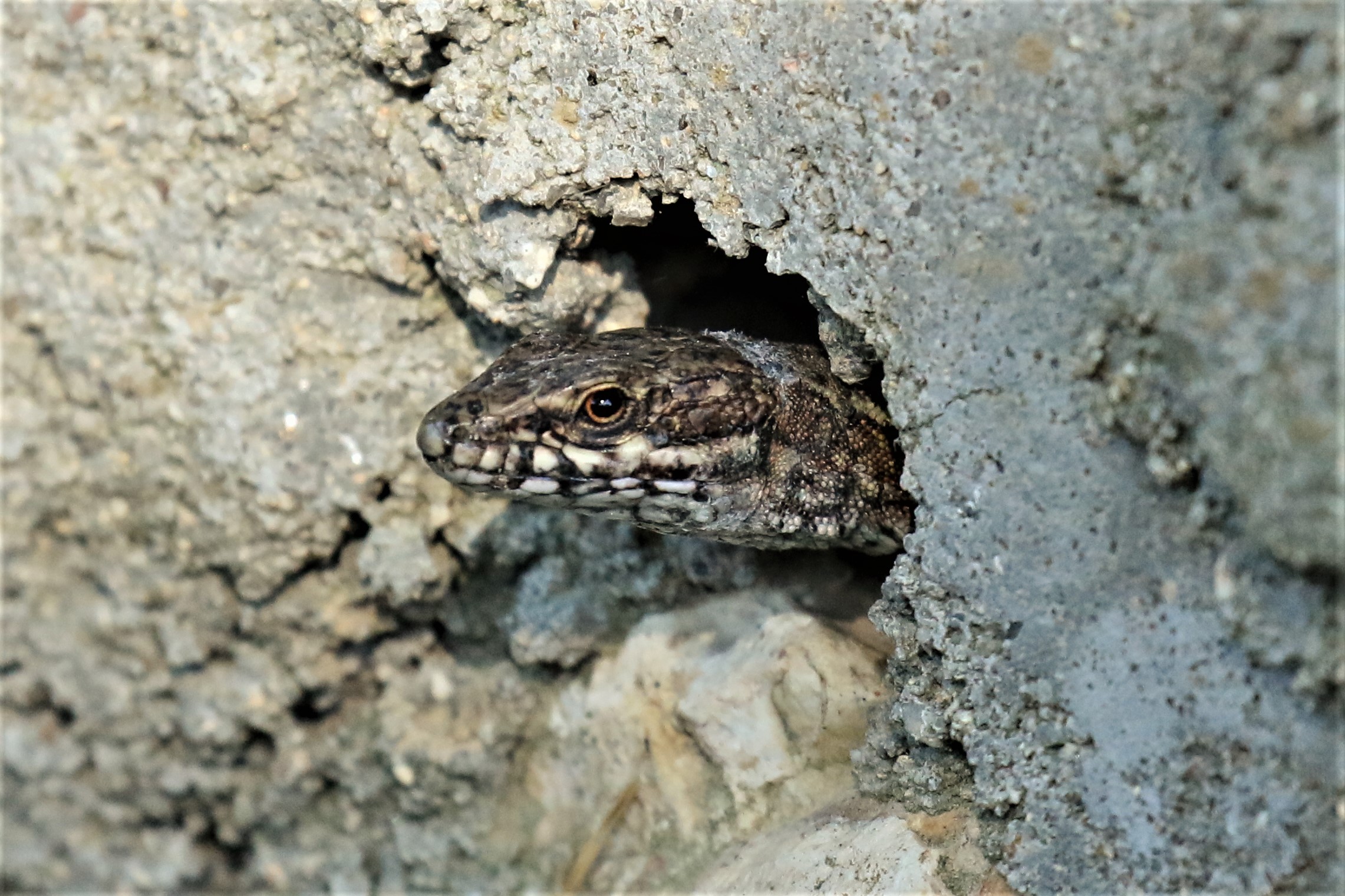
Interestingly there are six different morphs of this species based on colour so there is, amongst others, a green morph, a red morph and a white morph. However the differences between them extend beyond just their colour. For example the yellow morph produces more eggs but they are small and the white morph produces fewer but larger eggs. This is seen as an adaptation to climatic conditions. Where the climate is more favourable the species can risk producing more offspring but when it is less so it is better to produce fewer but bigger youngsters which may survive more easily.
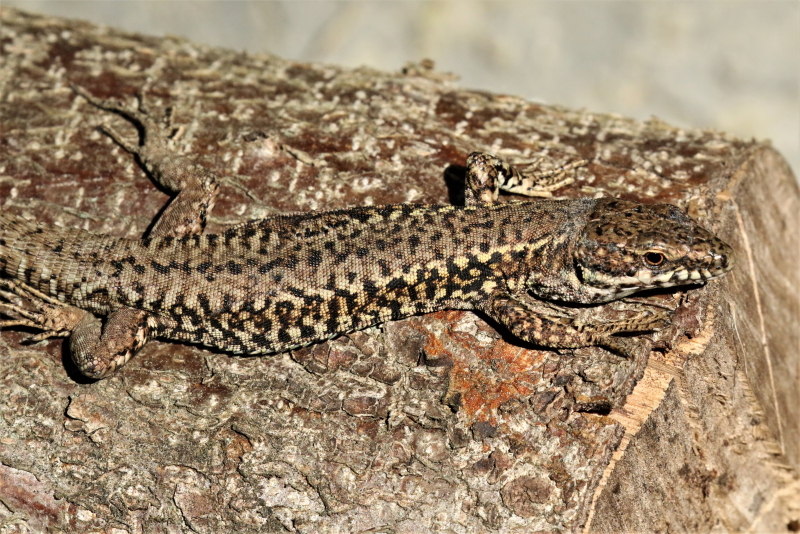
Other variations between the morphs include their resistance to different diseases and the types of pheromones that the males produce to attract females.

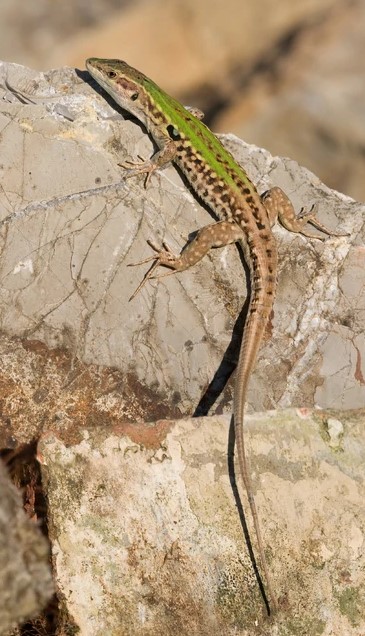
There is a related species called the Italian Wall Lizard which lives in the Britain and there is an established colony in Dorset. A small number were accidentally introduced into Buckinghamshire when they were imported with a consignment of Italian tufa stone. They were all captured to prevent the spread of another alien species.
Turning to the invertebrates, there is a butterfly called simply the Wall, or sometimes a Wall Brown (Pararge megera).
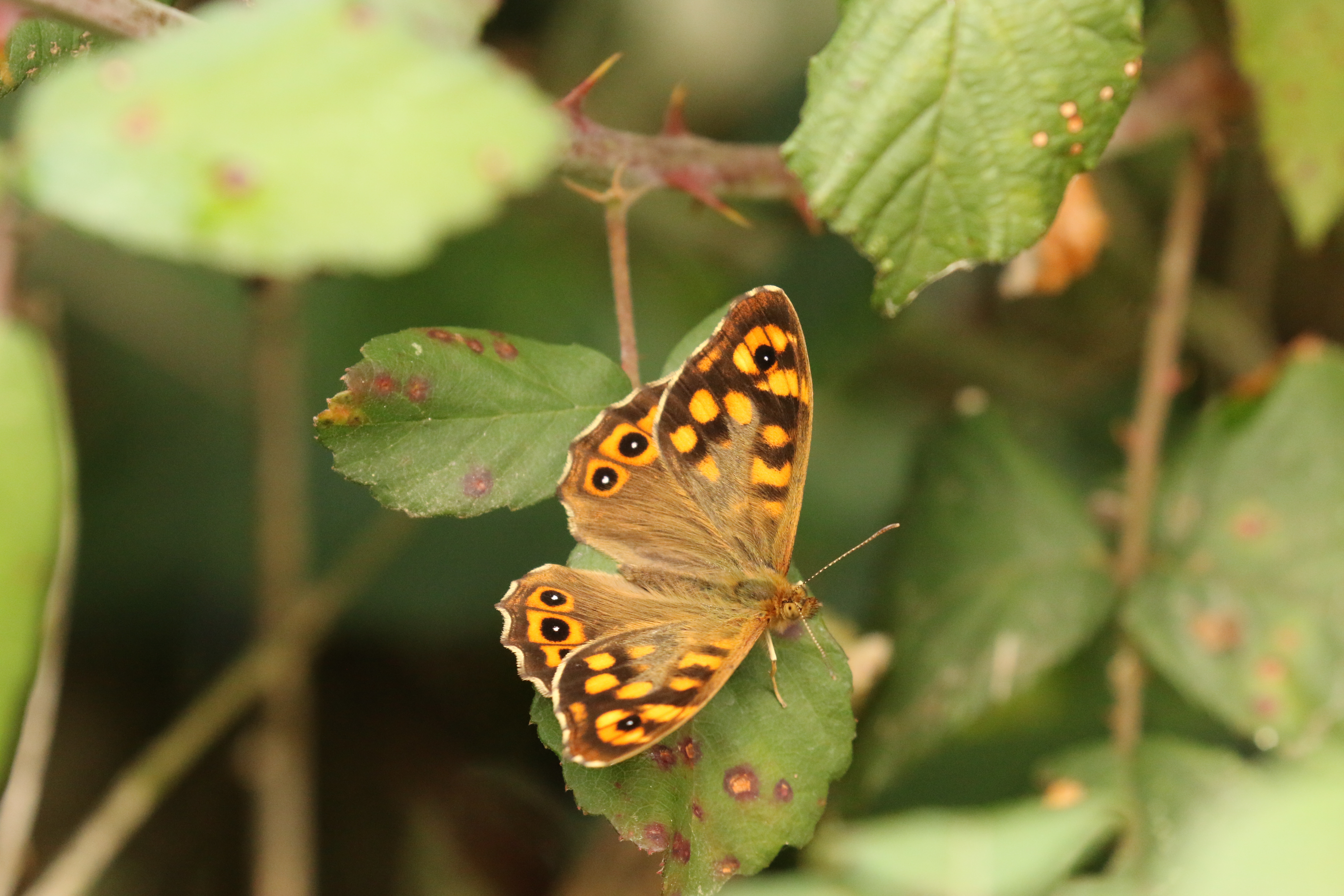
This was fairly common when I was a boy, but I see it less often now, possibly because I grew up in Essex and now live in Gloucestershire, or maybe because there has been a general decline in butterfly numbers. This species, more than most, seems to love to sun itself so will seek out places to bask and walls provide it with that facility. It will also make use of sunny hedge banks, tree trunks and gravel pits, in fact anywhere sunny and warm. Its caterpillar feeds on various coarser grasses such as Couch Grass and Cocksfoot. The caterpillar overwinters and so needs to find somewhere sheltered and predator proof to survive from November to March when it will turn into a chrysalis just briefly before hatching out in early May. There will be two or maybe three broods in a year so the numbers of adults will increase later in the summer.

There is a large group of spiders called Wall Spiders but only one of these has been found in Great Britain and even then very rarely. They are generally found in warmer countries. Today as I write this temperatures are set to reach 40 degrees in some parts of the UK, a new record, so maybe the Wall Spider will start to turn up more frequently. The species which has been recorded in the Britain is Oecobius navus and it has only been seen three times.

It is not that impressive in terms of size being only 2.2 to 2.5 millimetres long, but it does have some interesting features. It makes a small particularly fine pad of web in a crevice in a wall. It has an organ called a cribellum through which its thread of web passes and this splits the already fine thread into multiple smaller threads, which serve to entrap small insects. When an insect gets caught the spider bites it thereby introducing sufficient poison to paralyse it so that the spider can then eat it at its leisure. It will also run round and round its prey at the same time as producing these very fine threads and thus further deactivate it.

Finally in terms of animals with wall in their name there is a small spire shaped snail called a Wall Snail Balea perversa, also known as the or tree snail. I have them in my garden wall. They appear during damp conditions and today they will be hiding deep inside the crevices to avoid the heat. They feed on algae and lichens which grow on the surface of the rocks that make up the wall. They are small, less than 10 millimetres in length but they are beautifully constructed with a fine spire shape.

Mason Bees frequent walls and again my French house is home to many of them which is not ideal as they excavate little tunnels in the mud mortar that holds the walls together. The Osmia genus is the main group of bees excavating holes in walls and there are several in Britain the commonest of which is probably the Red Mason Bee (Osmia rufa). Its scientific name gives a better description of its colour which is not red but decidedly ginger.

There is also Osmia coerulscens , the Blue Mason bee. It is actuallygrey, maybe steel blue at a pinch.

There are many other species which make good use of walls including certain molluscs, woodlice and springtails but I have not found any with wall in their name. There are Plaster beetles and mites which occur on newly plastered or damp walls where they feed on fungus growing on the damp plaster.
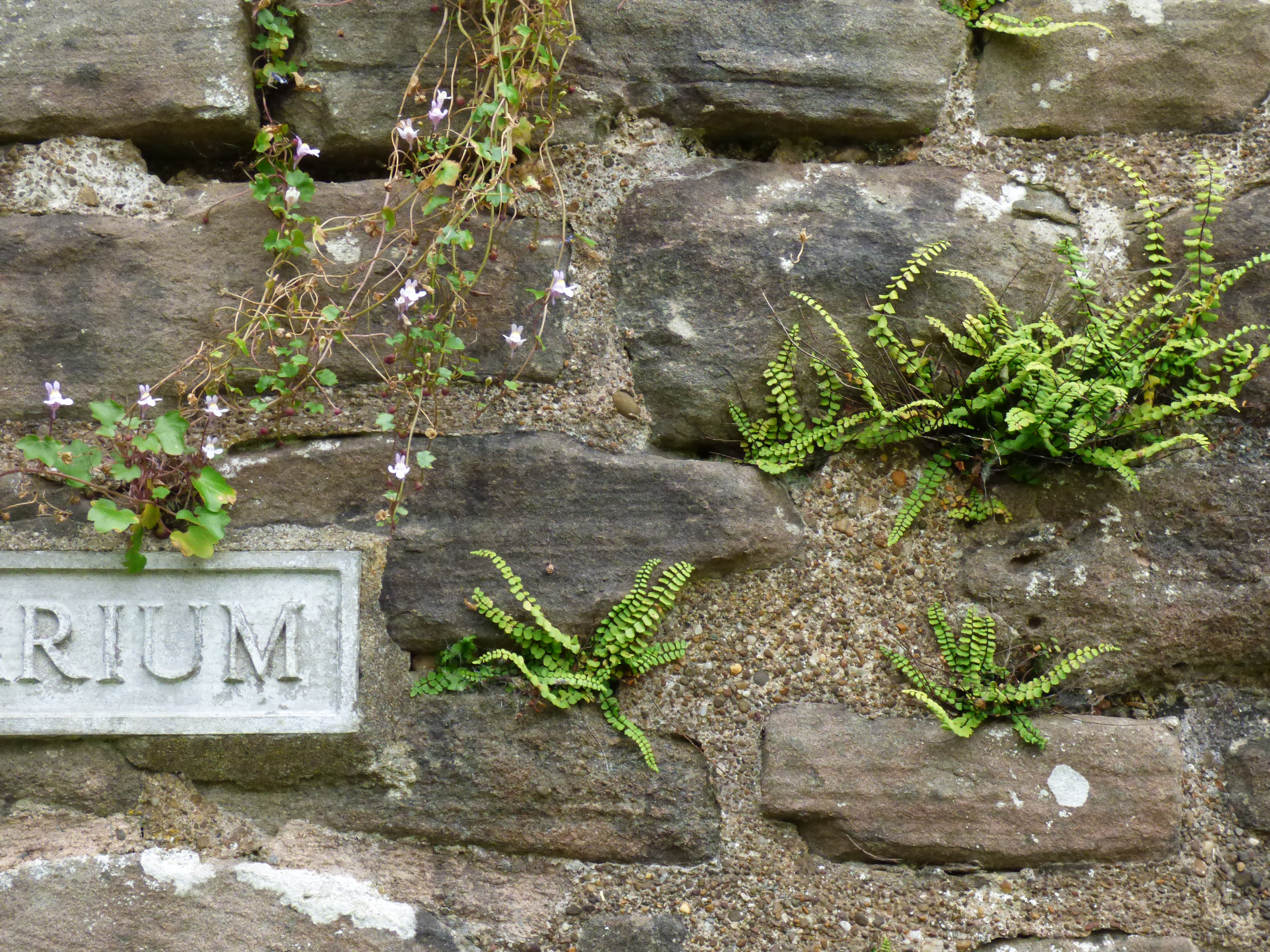
Maidenhair Spleenwort and Tintern Abbey, Monmouthshire.

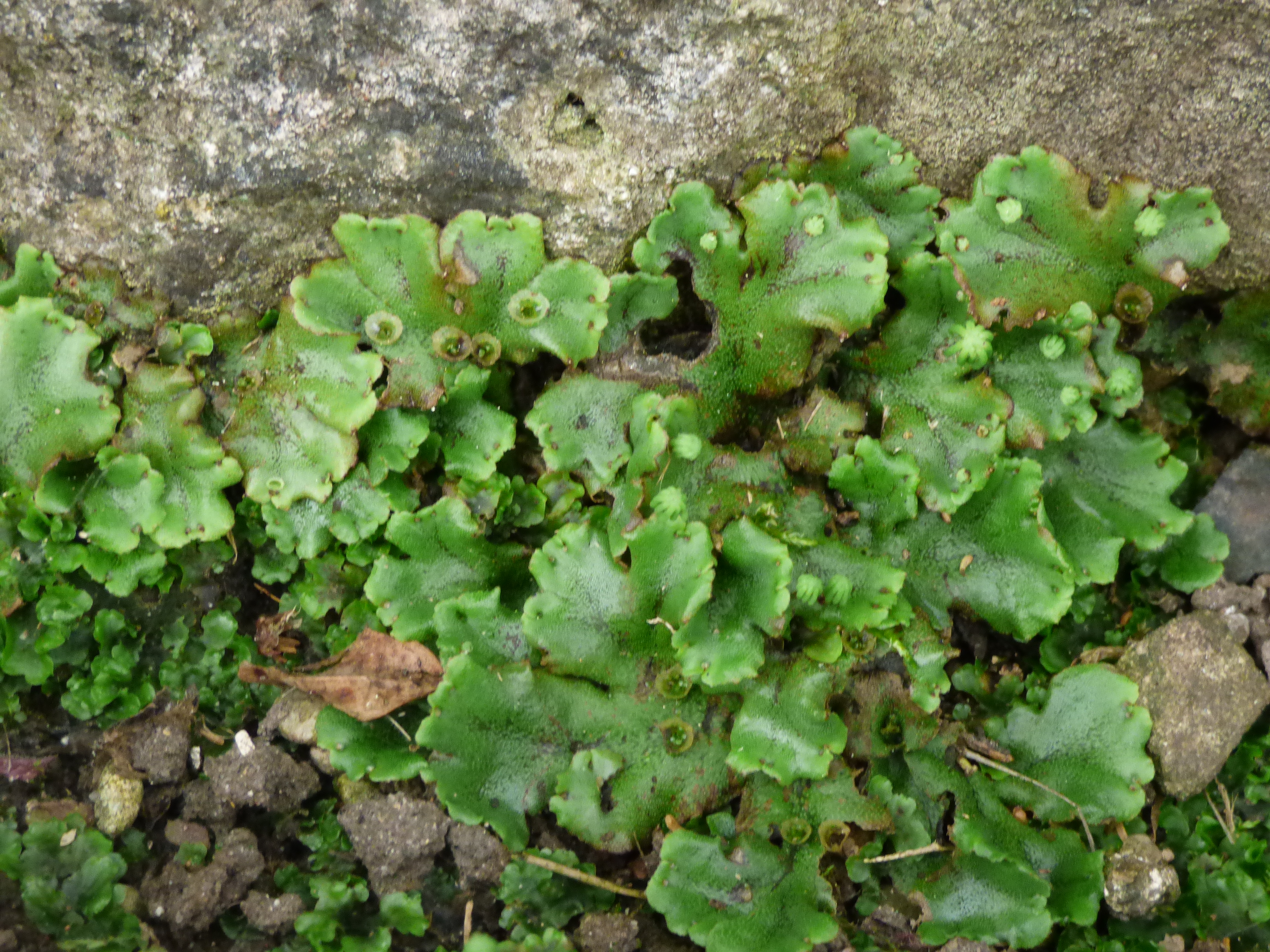
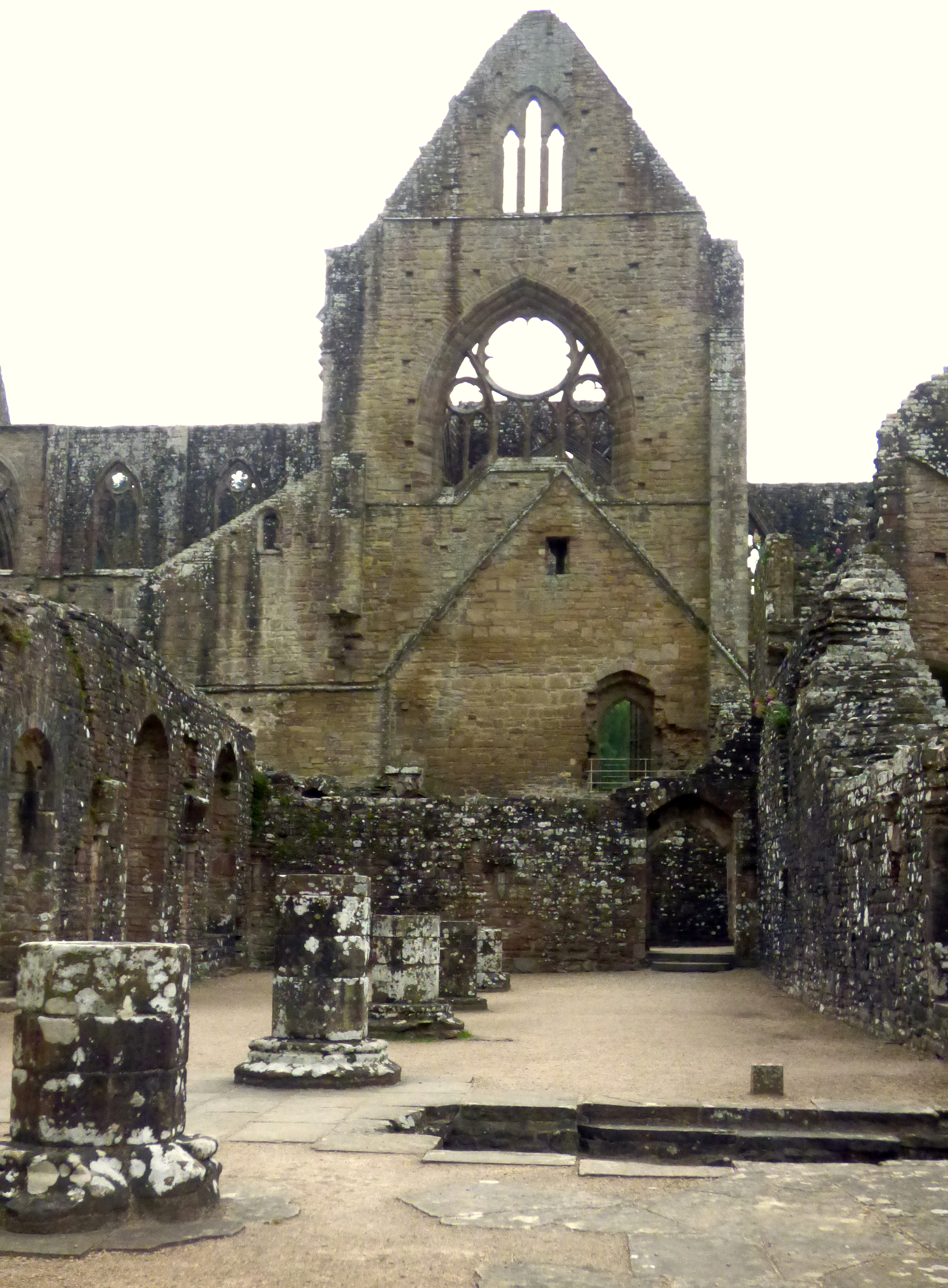
On a recent visit to Tintern Abbey there were not that many wall flowers to be seen. Careful maintenance is obviously required, plants growing from crevices in the stone work can add to the look of the walls but can also hasten their disintegration. In fact the interior region of the Abbey was largely a restricted area when I visited, due to a combination of the possibility of falling masonry and maintenance work to rectify the problem. It was obvious that herbicide had been applied round the bases of the walls. All that survived in these regions was a liverwort called Marchantia.

There are a few flowering plants and ferns growing in the walls but not many considering the age of the buildings. The majority of plants are growing from the top of the walls where their removal would prove more difficult. There was some Red Valerian, though most of it was the pink form, also some yellow flowers which were some species of Hawkbit ( this group is notoriously difficult to identify) There was quite a lot of Ivy-leaved Toadflax, as always, and a few small patches of White Stonecrop. The commonest plants by far were the ferns which were mostly Maidenhair Spleenwort but also some Wall Rue.

Spleenworts are one of the commonest ferns, there are several species but Maidenhair Spleenwort (Asplenium trichomanes) is by far the most prevalent, infact its distribution is world wide, I suppose ferns have had longer to spread than flowering plants! If we want to get scientific then Maidenhair Spleenwort is a polyploid complex meaning it can have different numbers of chromosomes and this influences the way the plants look so that it has been split into three subgroups and these have different geographical locations and slightly different morphologies. Hey ho, don’t look too closely and they all look the same.

Despite being a ruin this is still the most amazing place, it is set in the Wye valley and so it does benefit from the surrounding scenery. How it would have looked like prior to Henry’s activities one can only imagine but it must have been even more magnificent. It would have been wonderful to see the windows with glass in, no doubt stained glass depicting all sorts of religious scenes, probably also Roger Bigod, Earl of Norfolk. The abbey church was rebuilt under his patronage, he was Lord of nearby Chepstow Castle, in the late 13th century. The reconstruction maintained the original design of the monastery..

Henry VIII dissolved the abbey in 1536 along with most abbeys throughout Britain through his Dissolution of the Monasteries. On 3 September 1536, Abbot Wyche, 12 monks, and 35 monastic servants surrendered the Abbey to the king’s visitors. The king granted the abbey to the then Lord of Chepstow who sold the lead from the roof. From that point, the abbey lay forgotten, falling into ruin for the next couple of centuries.

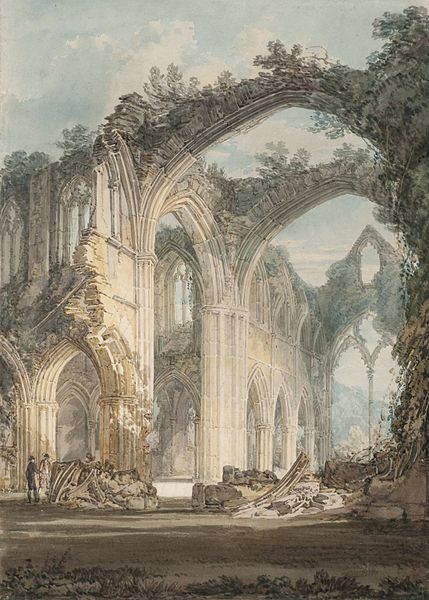
After the dissolution and the removal of the roof for the lead the abbey was largely ignored for the next 200 years, some stone was removed for the construction of local buildings but mostly it was colonised by Ivy. It was later that it became a tourist destination with famous artists, poets and writers visiting. Turner visited the abbey in 1792 when he was only 17 years old and painted it, on canvass that is, not with a pot of paint and a ladder. You can see plenty of plants indeed bushes growing from the walls in his depiction. Also Wordsworth was another famous visitor some time later.

Incidentally there are several different species of Spleenwort, the commonest is Maidenhair Spleenwort but you could come across Green Spleenwort where the central midrib of each leaf is green not brown. There is also Black Spleenwort which has leaflets that are complex not simple and the central midrib has a double groove along it. I describe that fern when visiting a Roman village now called Wall which is in Staffordshire. And finally there is Sea Spleenwort which has a coastal distribution, largely western and it has bright green fleshy leaves. So there is more to Spleenwort than you might have thought.

Dark Mullein (Verbascum nigrum) and the Theatre at Verulamium St Albans.

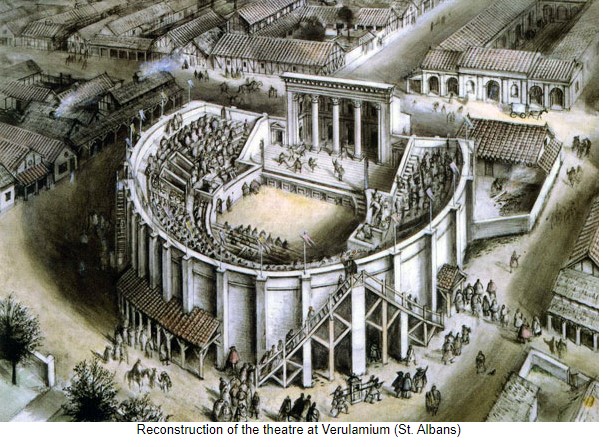
I always thought it was an amphitheatre, but it is not, it is a theatre. The difference is that a theatre has an arena and a stage whereas the amphitheatre just has an arena and so this makes the St Albans site unique in Britain. (‘quite unique’? is that allowed?)

The Roman Theatre of Verulamium was built around 140AD it is the only example of its kind in Britain. Initially, the arena would have been used for anything from religious processions and dancing, to wrestling, armed combat and wild beast shows ( mainly bulls and bears). From about 180AD the stage came into greater use and the auditorium was extended. By about 300AD, after some redevelopment work, the Theatre could seat 2000 spectators.

Actually only five such structures are known in Britain and only one was a theatre, so it seems drama and music were not that popular with the Britons. The Celts seemed to prefer the more brutal entertainment of the amphitheatre, with its wild beast fights and gladiator shows. In fact, some of these theatres seemed connected to temples, and so it may have been more religious Celtic ceremonies that took place in these theatres.

St Albans is the most famous site and was known as Verulamium in Roman times, this is because it was constructed on the site of Verlamion, which was the capital of the iron age tribe known as the Catevellauni. In AD 61 Verulamium was largely destroyed by Boudica and then reconstruction began. The theatre came somewhat later, and there was a temple right next to the theatre.

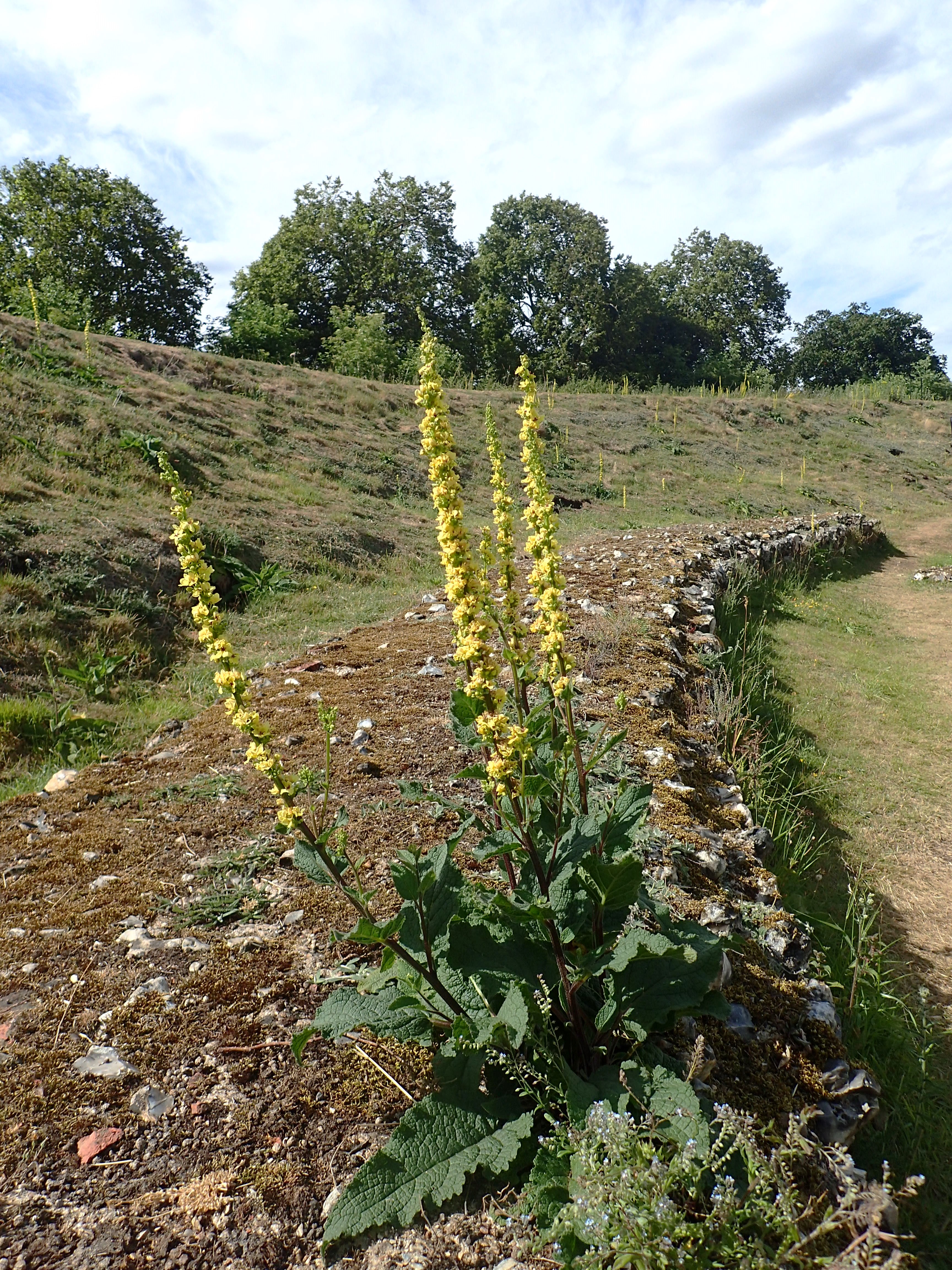
There were quite a few plants growing from the stonework when I visited at the end of June, lots of Forget-me-not which was reaching the end of its flowering season. There was as always a lot of Ivy leaved toadflax and several ferns, but most impressive were the Dark Mullein which were in full bloom. They are biennials and produce a rosette of leaves in their first year rather like Foxgloves and then the flower spike develops in the second year, this is usually unbranched unlike several other species of Mullein. The flowers are yellow with five petals fused into a tube from which the anthers project, these have large purple hairs on them making the centre of the flower look purple. This species is quite common in the south of England particularly in a diagonal SW to NE band roughly following the Cotswolds and Chilterns. Suffice it to say this species is a calcicole and prefers a chalk or limestone substrate. Walls made from such materials will obviously suit it well, it also likes a sunny position so again banks and walls be to its liking.

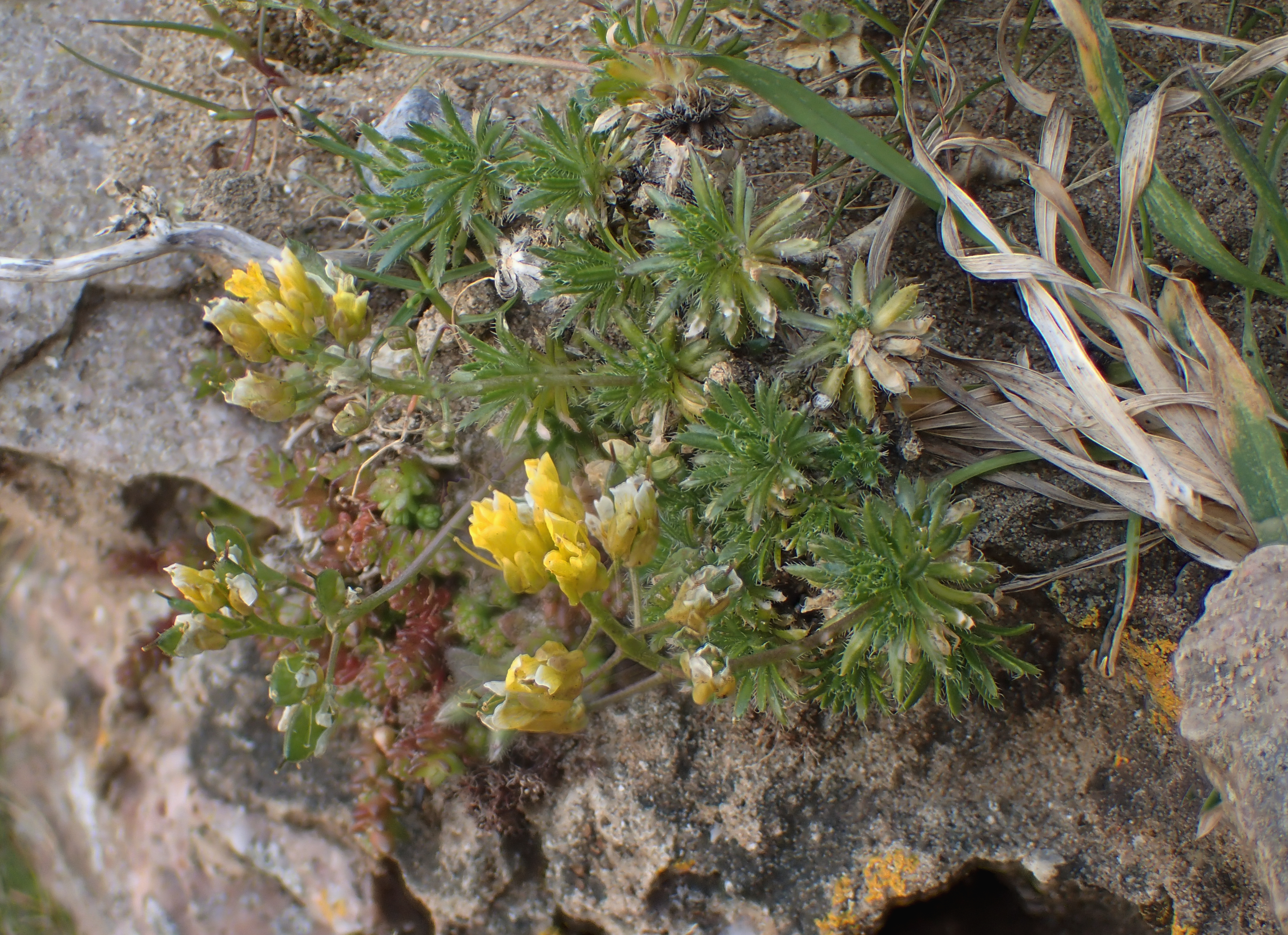
Yellow Whitlowgrass ( Draba azoides) and Pennard Castle, Gower.
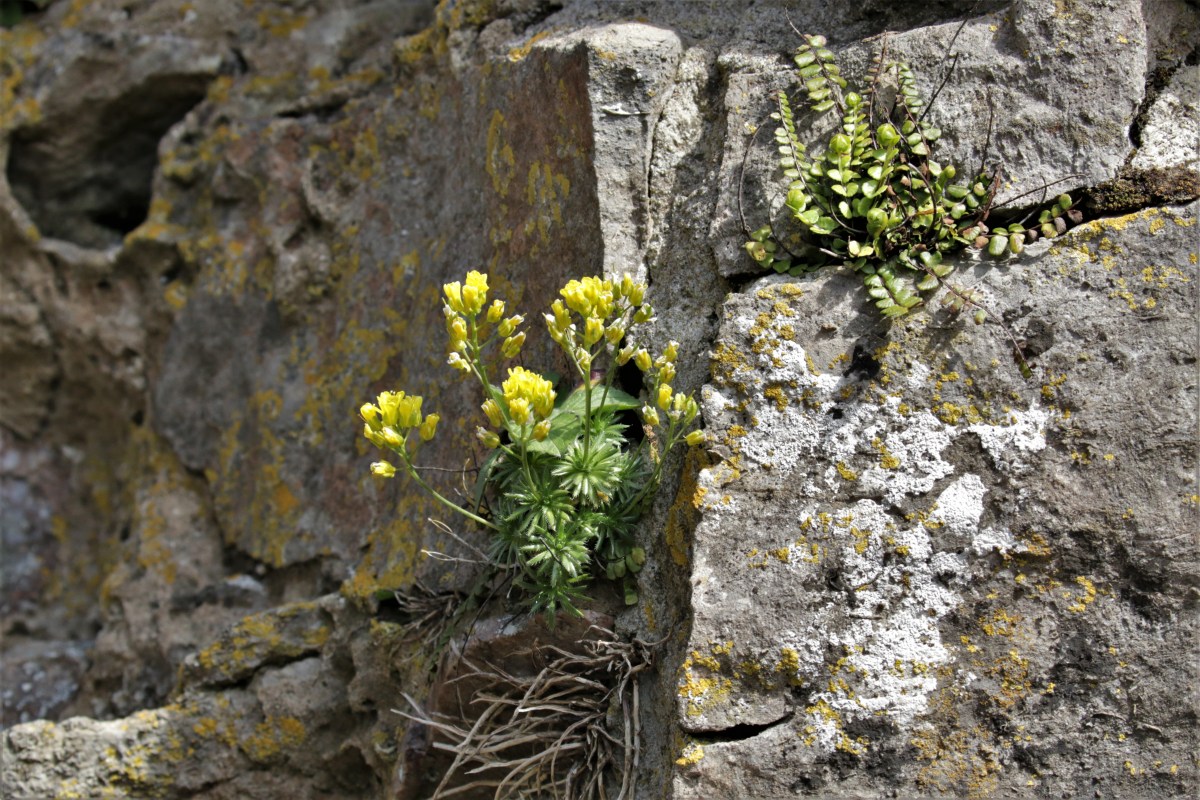
This is a plant surviving from the times prior to our last ice age, but only just.

It is limited to a small section of limestone cliffs on the south of the Gower peninsula from Pwlldu to Tears point, which has Oxwich bay in the centre so it only adds up to about 17Km or 10 miles of cliff. It is estimated that there are no more than about a thousand specimens in this area. Pennard castle which was constructed from the local limestone also supports a small population. Two things point to this plant being a survivor from before the last Ice Age. In the vicinity a 33,000 year old skeleton was found, it was named the Red Lady of Paviland because the bones were died red but it was subsequently determined that it was a man not a woman. Now the significance of this find is that it points to the fact that despite the cold it was possible to inhabit this region at what would have been the height of the last Ice age, so if humans could survive there then plants and other animals would presumably also be able to cope. These regions where life was able to carry on during the last ice age are known as ice-age refugiums. The ice cap only came down (roughly) as far as a line from Humber to the Severn so whilst conditions south of this would have been harsh these regions possibly because of the local topography were able to support life.

The yellow dots on the walls to the left of the window are patches of Yellow Whitlowgrass in flower.

Further evidence comes from DNA analysis which shows that the individuals growing in south wales are quite distinct from those on the continent suggesting that this is a continuous line of colonisation and not a reintroduction after the ice age as is the case with most of our flowering plants.

In Continental Europe it has a mainly alpine distribution, occurring between 900 and 3,400 m in the Alps and extending eastwards from the Pyrenees to the Carpathians, and westwards from the Alps to the Jura. A small isolated population in the Ardennes appears to be a pioneer one, not a relict. It is decreasing in places mainly owing to habitat destruction caused by road widening, afforestation or tourist pressures.

Pennard Castle was first built in 1107 by Henry de Beaumont, Earl of Warwick after he had been granted Lordship of Gower by Henry 1 and is believed to be one of at least 7 built by him on  the Gower. The reason was because local Welsh tribes were not so happy with the Norman take over.  The initial castle was a timber ringwork – common following the Norman invasion and consisting of a defensive ditch, ramparts and a timber hall. later the limestone structure replaced the timber. The castle was only occupied until the 1600’s and has gradually declined ever since helped by the wind blown sand etching away at it. Restoration work has been carried out in recent years. On my visit a local who knew all about the importance of the site and the presence of the extremely rare plant told us that a misguided but well intentioned local had carried out some repointing on his own initiative and this had resulted in a big decline in the Yellow Whitlowgrass population. Careful management is needed to preserve this species which so far has survived for maybe 100,000 years.