
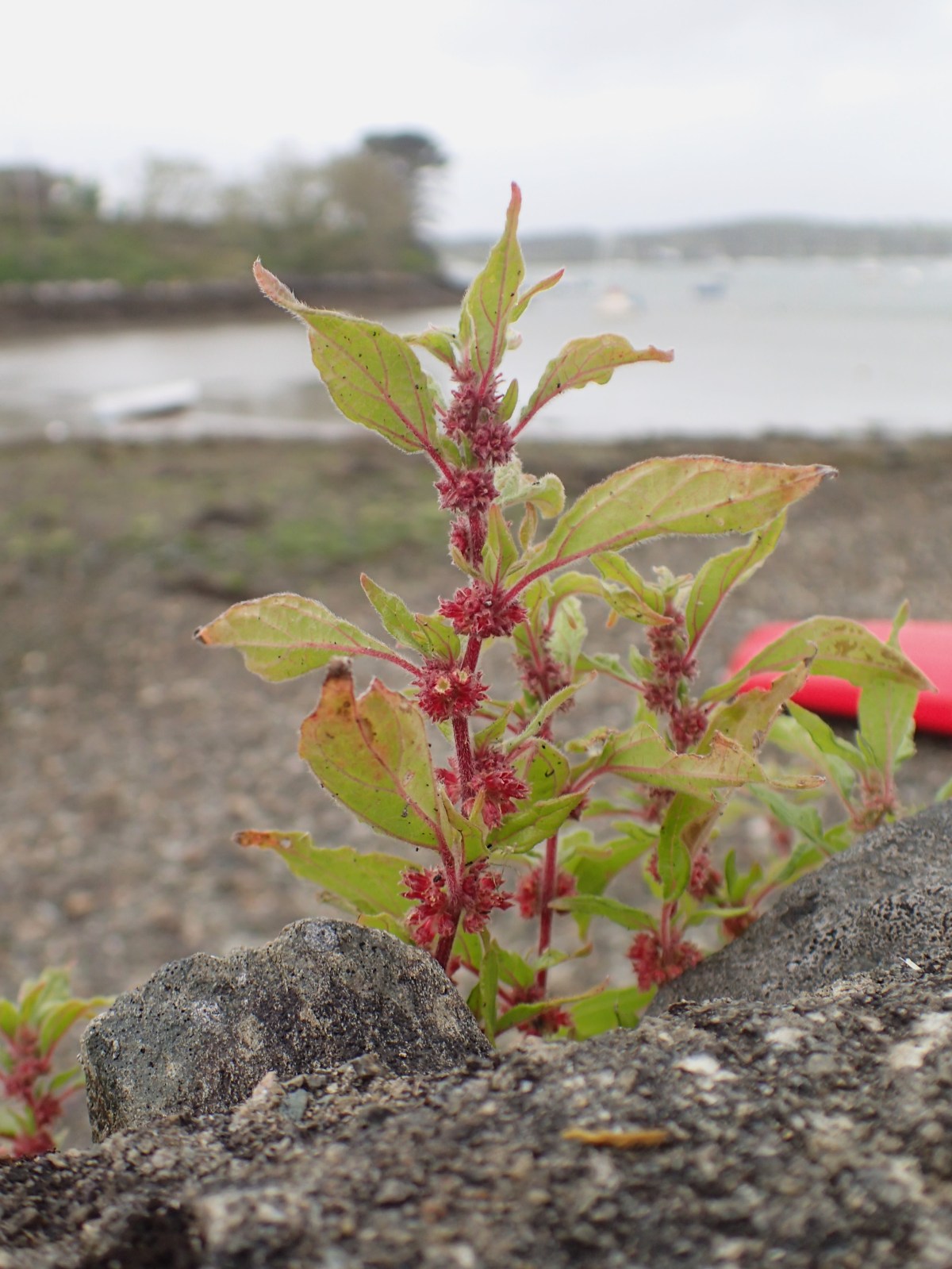
Pellitory of the Wall is an odd sort of name but it does indicate that this plant is almost always associated with walls. The pellitory part comes from peletre which is Old French or piretre, also from Latin pyrethrum, from Greek purethron, and from pur fire, due to hot pungent taste of the root
This one was growing out of a harbour wall in Baltimore southern Ireland however it is not found just by the coast but often inland.. I have seen it growing out of old castle walls, I have seen it in southern France and in some Roman ruins in Spain . It also grows close to my home, out of the walls of Tintern Abbey. 
Its scientific name is Parietaria judaica, and it has a couple of common names, spreading pellitory or pellitory of the wall. This is a herbaceous perennial and is in the nettle family Urticacae, its flowers are quite similar to those of the Stinging nettle though they are red in colour.. The plant’s pollen is highly allergenic and can cause asthma, in fact in Australia its common name is Asthma weed.
Baltimore is at the very tip of Ireland , next stop the Fastnet Lighthouse and then America; the Titanic sailed past this last point of land on the south coast of Ireland on 11th April 1912. Some of the passengers would no doubt have been on deck looking out as Ireland disappeared into the distance, and for many it was the last sight of land they would ever see. It had set sail from Queenstown which is just outside Cork at around 1.30pm on 11th April. I say around 1.30 because some accounts say 1.30pm, others say 1.40pm and some even 1.55pm. Given that this crossing was also going to be an attempt to break the record for a transatlantic journey I would have thought and accurate record of the exact start time was a prerequisite. It made a brief stop at the Daunt Lightship so that the local pilot could disembark and then it was full steam ahead. It would have probably passed Baltimore just about one hour later.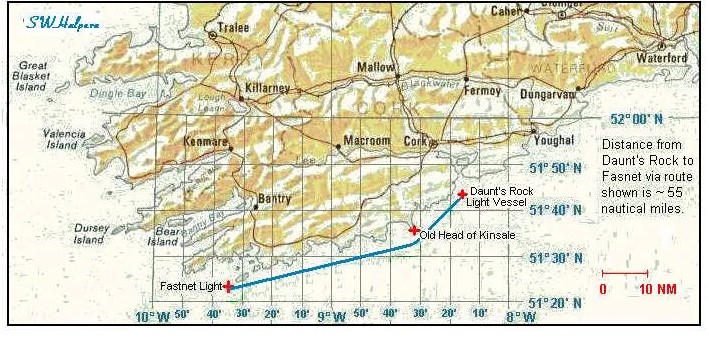
(Baltimore is on the coast due south of Bantry)
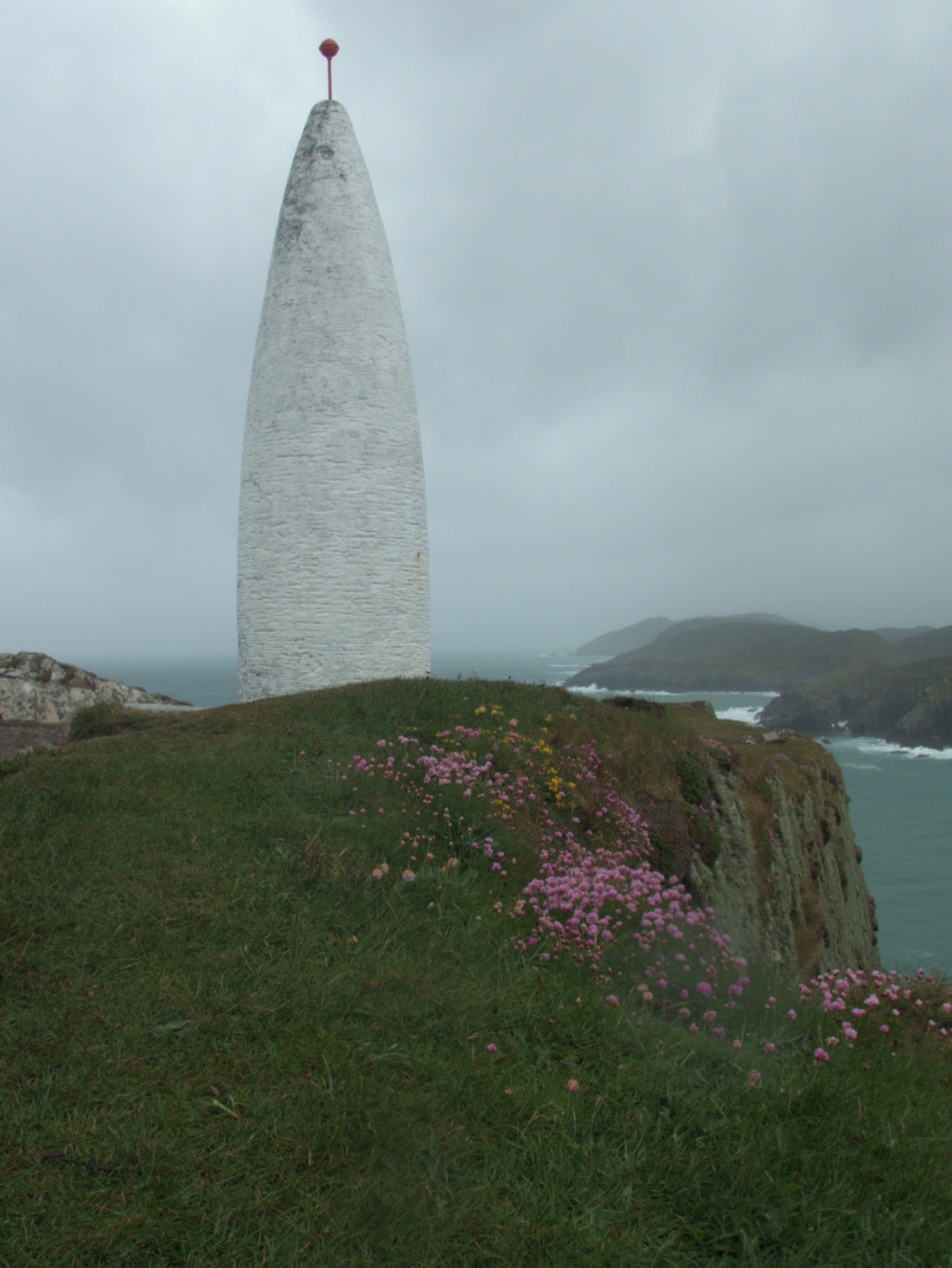
Had you been stood by this wall that is just a short distance along from the harbour at Baltimore you probably would not have seen the Titanic, your view would have been blocked but had you walked on a short distance up to the beacon then you almost certainly would have seen her out in the distance, on route for the Fastnet Light house and then the broad Atlantic ocean.
However a lot would have depended on the visibility, on the day I went up to the beacon you would not have spotted a rowing boat one hundred yards off shore, though I suspect most rowing boats would have not ventured out in that weather.
 Walls and Flowers