
Whilst I am concentrating on what are known as the Vascular plants that inhabit walls one should not ignore the more primitive ones like the mosses and lichens. Incidentally vascular refers to having veins, well whilst plants do not strictly have veins and certainly not blood they do have specialised areas for transporting materials like water, sugars and minerals from place to place, the phloem and xylem and that is what vascular refers to and it is the flowering plants, conifers and even the ferns which are vascular.
Mosses and lichens are often referred to in one breath, but they could not be more different. They grow in similar places but in terms of their position in the classification of living things they are quite wide apart. Mosses are perhaps the easiest to understand and so lets deal with them first.
Mosses are a group of primitive terrestrial green plants. There are more primitive ones called Liverworts but as land plants evolved from aquatic species like algae then the Liverworts are still vey dependent on water and generally you do not find them on most walls. Mosses on the other hand have evolved so that some of them can survive in very dry conditions, having said that they do need wet conditions occasionally in order to reproduce. Mosses have also evolved so that they have a structure which is recognisably plant, ie they have a stem with leaves on and below the stem is a root like region, not proper roots but things called rhizoids which are primitive roots, they do the same job though in that they attach the moss to the substrate and help with absorption of water and minerals.
The mosses most commonly found on walls are those that grow in a compact little group so they look like a little green cushion, however if you carefully pulled it apart you would find that it is composed of lots of individuals all with a stem and tiny leaves and rhizoids at the bottom, just all squeezed together. This probably helps them retain moisture and survive. There are lots of mosses which can be found on walls but here are the most common ones. If in doubt then best to refer to the British Bryological Society.
Here are a couple of them.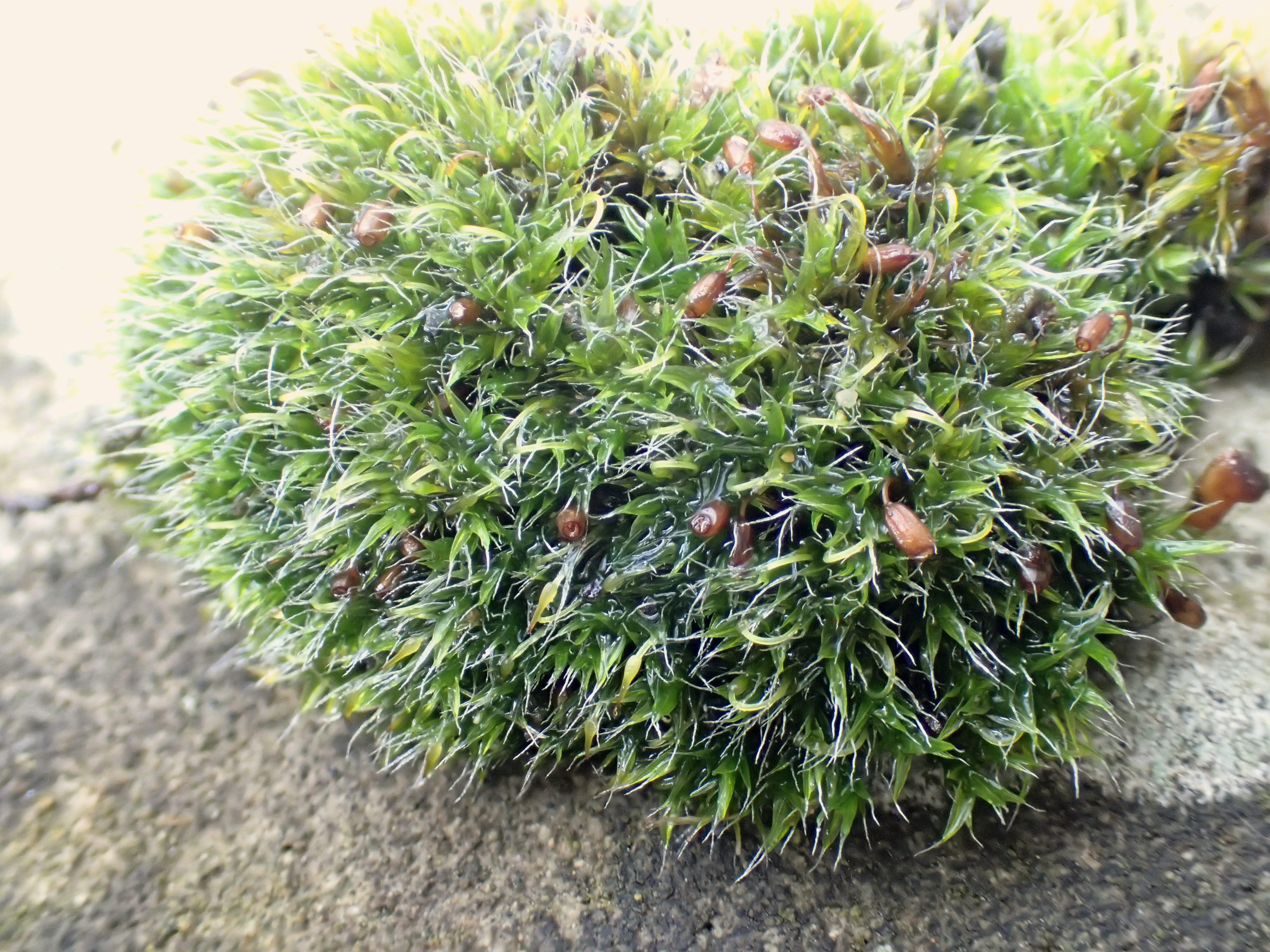
This is a cushion shaped one and you can see the brown spore capsules I think it is Grey Cushion Grimmia (Grimmia pulvinata)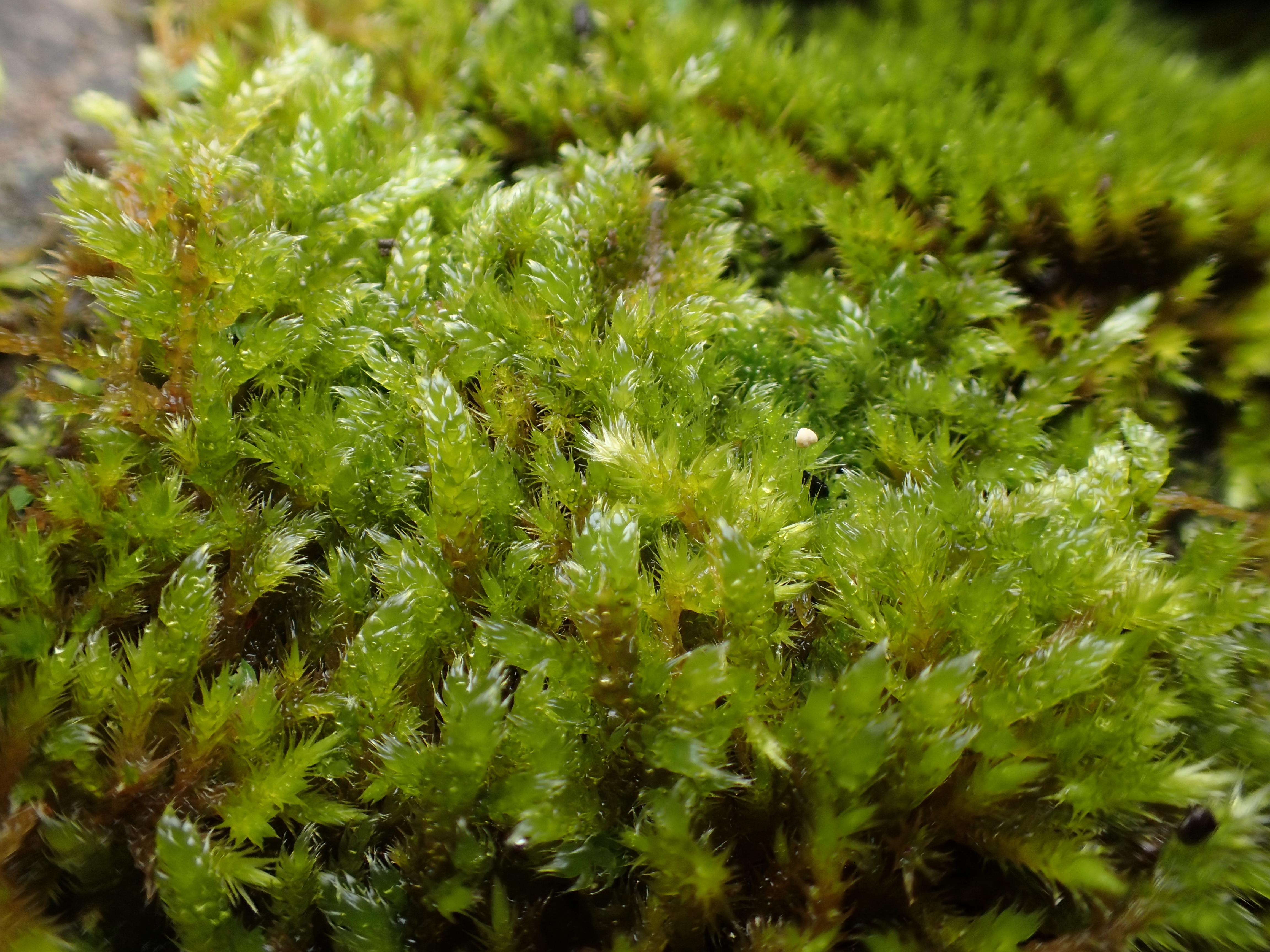
This is one of the few that grows out more like a mat and is called Silky Wall Feather-moss (Homaloththecium sericeum)
If you are in an upland area then the commonest one is called Woolly Fringe-moss, ( Racomitrium lanuginosum)
Lichens are another ‘kettle of fish’ what is the derivation of that one? Lichens are a symbiotic relationship between two different species, they are a combination of a fungus and an algae, and together they get on very well and can inhabit some of the most inhospitable places on earth. They are very slow growing and the one thing they can’t cope with is an unstable substrate, so they need something nice and fixed and steady to grow on, such as walls, gravestones, rocks and tree trunks. The basis of a symbiotic relationship is that each partner brings something to the table and they help one another, some would suggest it is like a marriage, I suppose that is not always necessarily the case! In the example of lichens the algal partner photosynthesises and produces complex foods like sugars which it then shares with the fungus….ahh. The role of the fungus is less easy to define but it sort of provides shelter and the algae which could not cope alone with the dry conditions is embedded in the fungal threads and thus protected.
As with the mosses there are lots of lichens that grow on walls, in fact far more and they subdivide into different types.There are those that just encrust onto the surface of the rock, others form a flat structure known as a thallus some produce a branching structure and are known as foliose and then there are others which produce upright little bodies sometime with the shape of a wine glass, these are called fructose. Fascinating and complex and unless you are an expert then often quite difficult to identify. 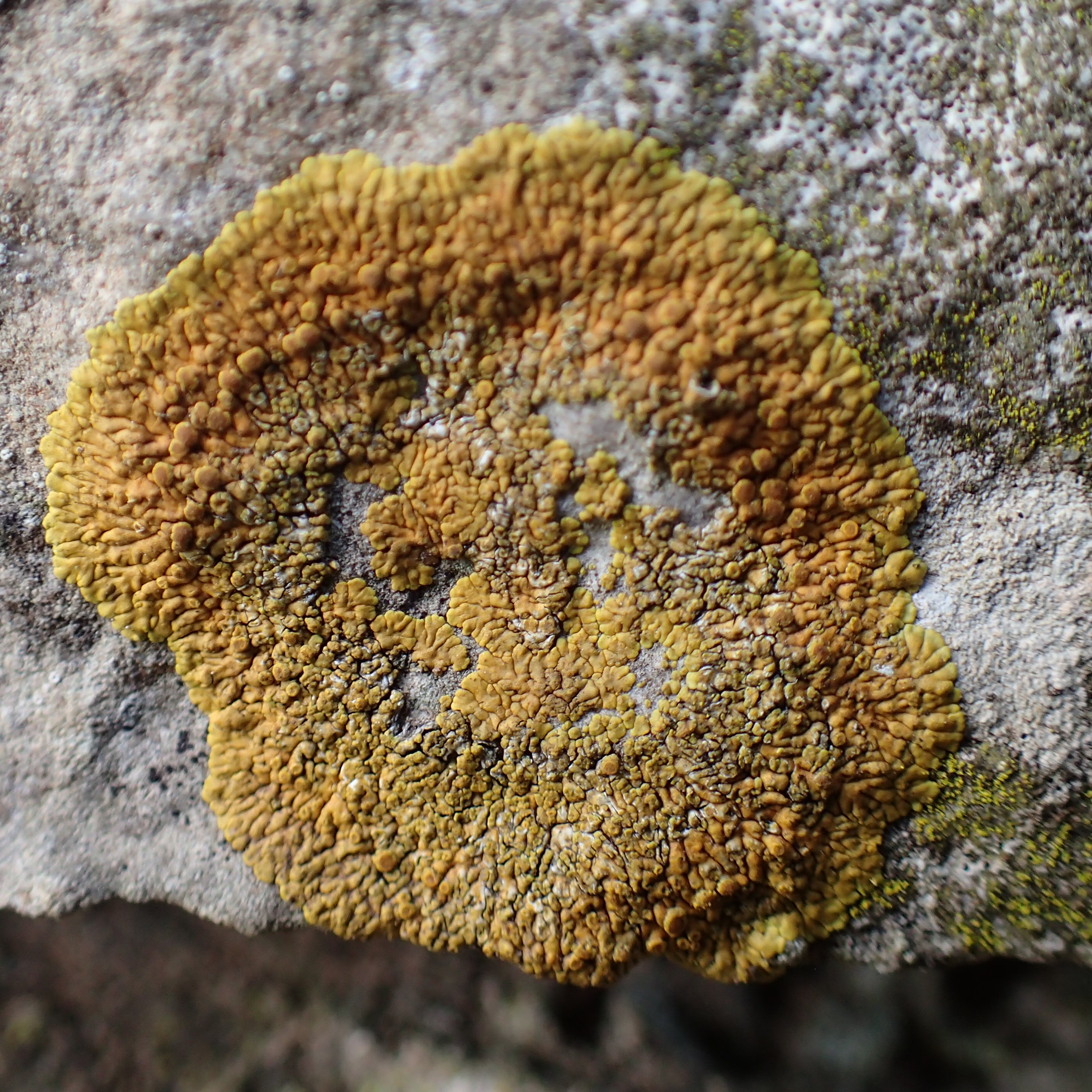
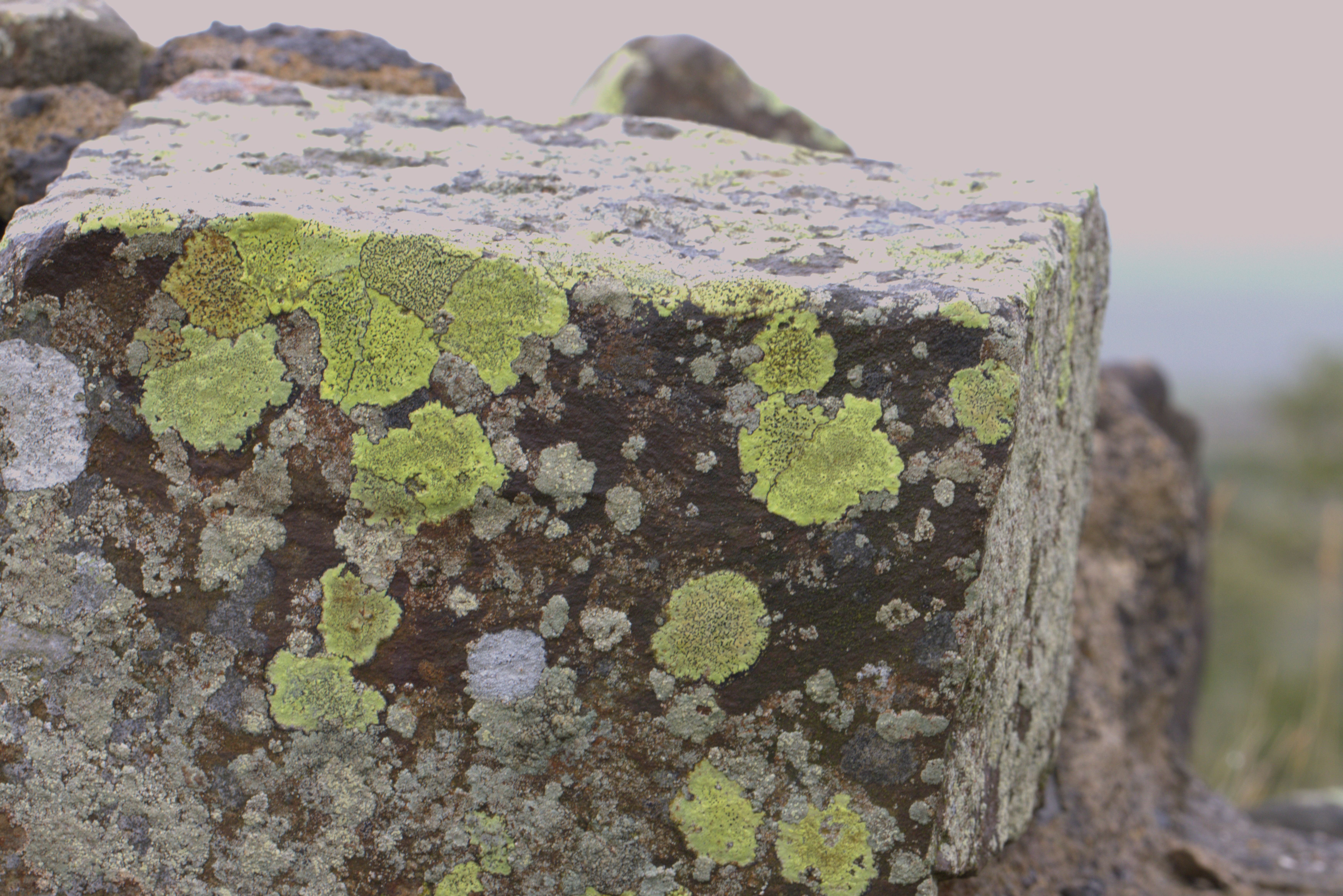
Acloplaca flavescens sorry they do not have common names.
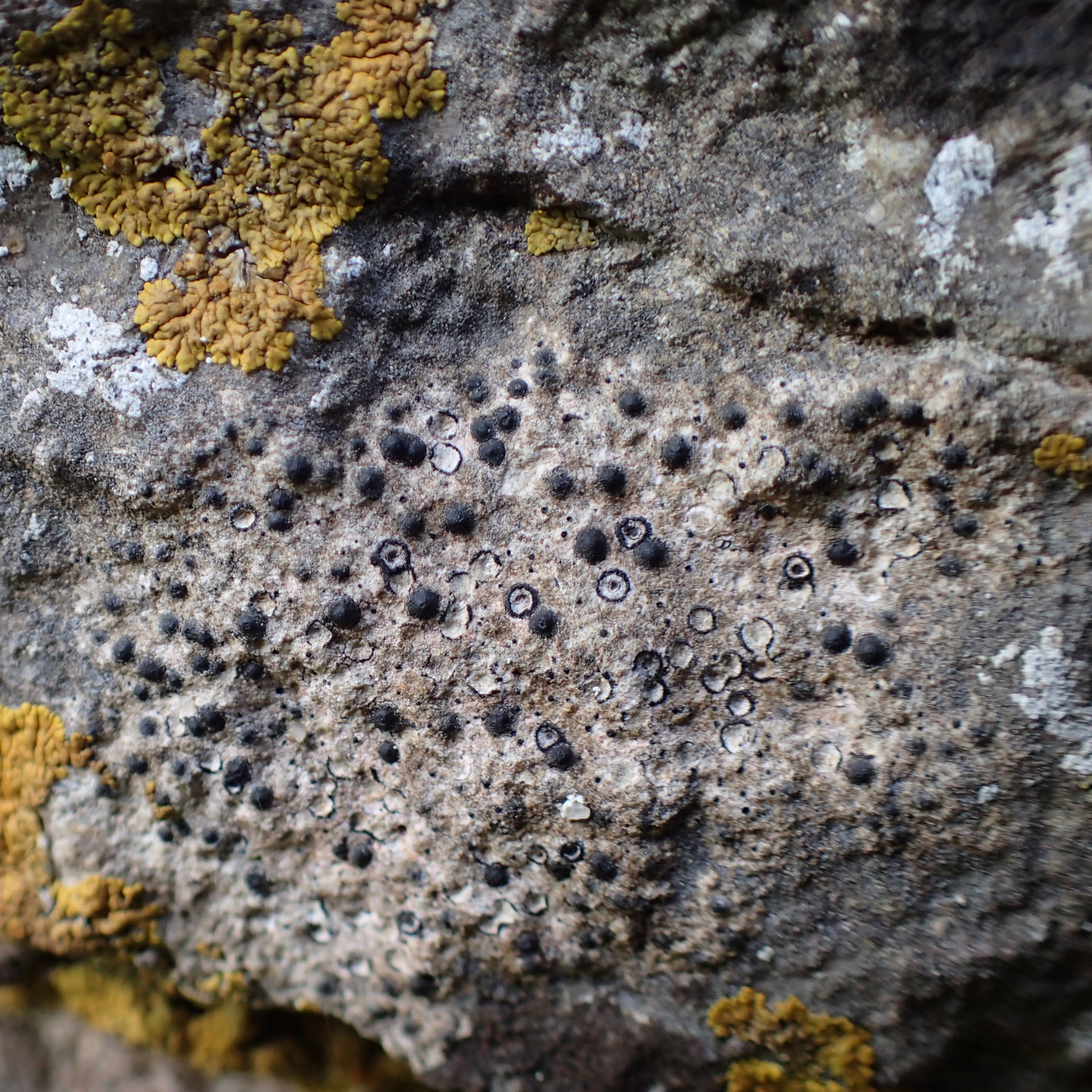
Acrocordia conoidea , this and Acaloplaca are both of the encrusting type.
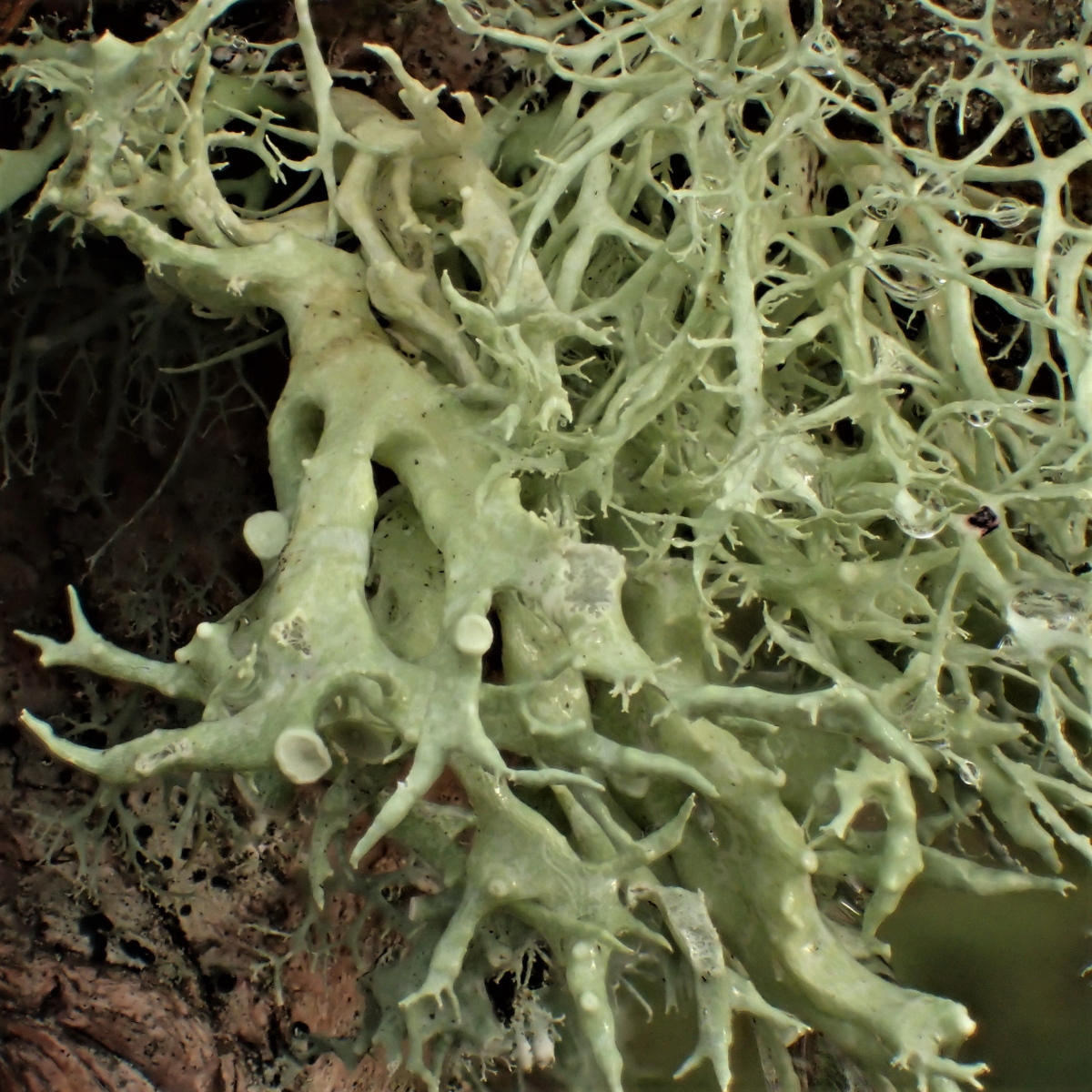
A foliose lichen, more often found on trees and called Ramallina.

This is one that produces little cup shaped structures. There are many that do this and most are in the genus called Cladonia so if you see something like this you can say ‘Hmm, looks like a Cladonia species.’ and you will sound knowledgeable and you will be right but there are vast numbers of them, this one could be Cladonia pyxidata, but I am not sure.
Apart from being beautiful and fascinating and an integral part of the plant life on walls, the mosses and lichens perform one very significant role in the ecology of walls and that is the development of organic material in between the rocks or bricks that make up the wall. The mosses in particular but also the lichens will over time die and break down, decompose and get washed into the cracks and crevices along with small particles of rock and gradually a substrate or soil will build up and this is essential for the large vascular plants which subsequently will colonise the walls. So these little plants the mosses and lichens are the forerunners, the pioneer species which start off the colonisation. They will be the first to arrive as they are dispersed by microscopic spores that blow on the wind and then once they land and if conditions are right they will set the whole long succession in progress. and they look great.

 Walls and Flowers