Fairy Foxglove and Ilkley Old Bridge

There are two bridges over the river Wharfe in Ilkley and the ‘Old Bridge’ and the ‘New Bridge’ The old one dates back to the 1620’s but that original one got washed away in 1673 and the present ‘Old Bridge’ was constructed in 1675. So it is quite old and consists of two spans and is quite narrow as it was designed to carry pack horses and people not cars.

It did get used for vehicles once they had been invented but that was banned in 1948 so now it is just people and bicycles and I suppose a pack horse would still be allowed to pass across.

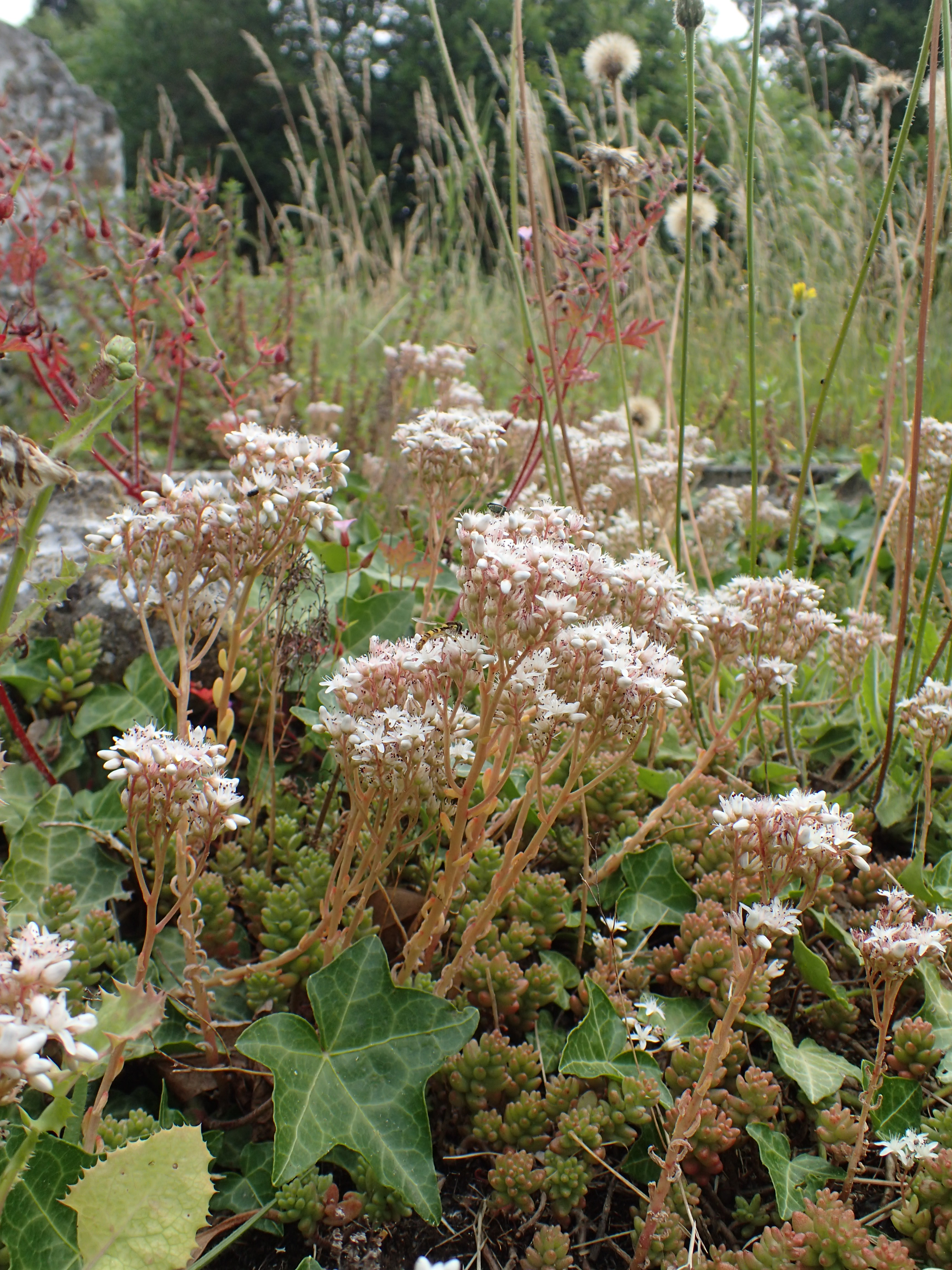
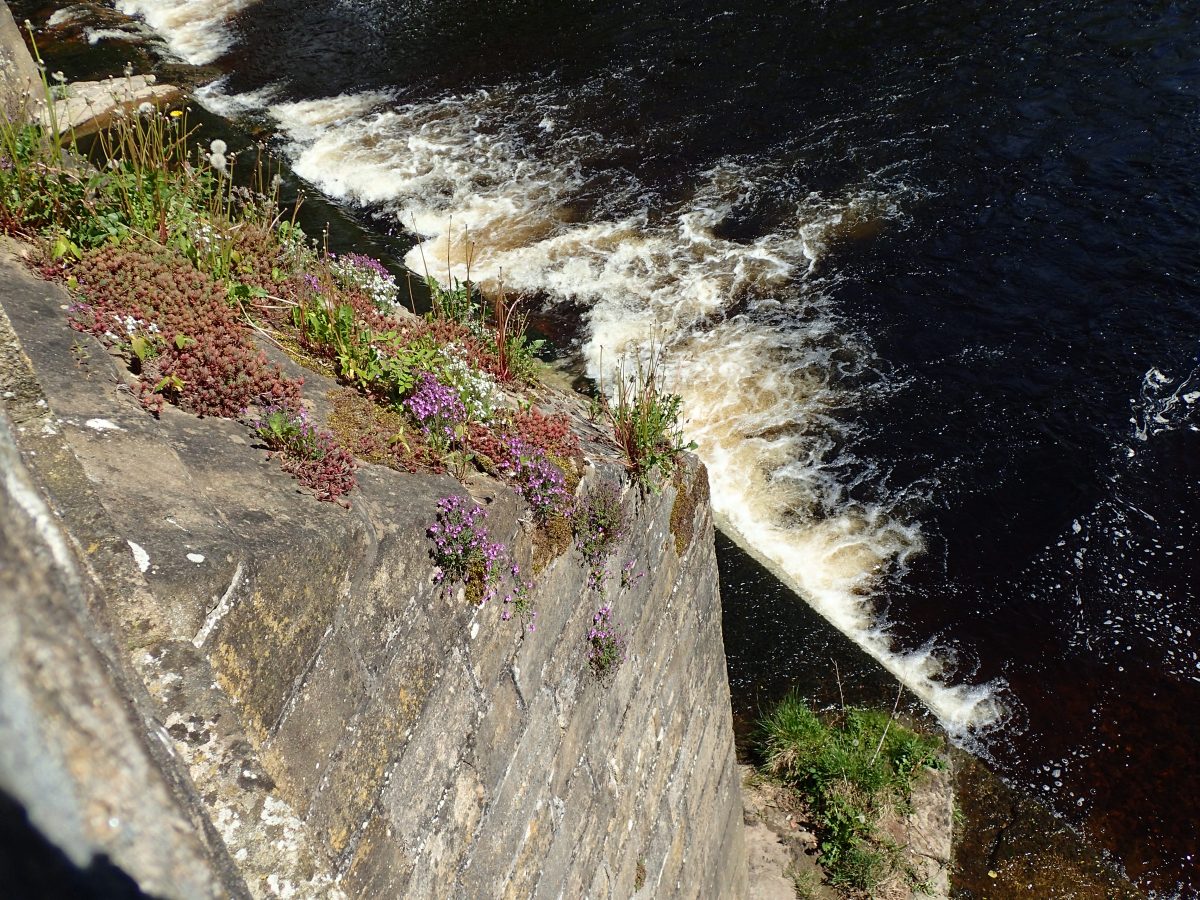
The Fairy Foxglove is growing on one of the buttresses that support the bridge along with several other species, including House Leeks. The foxglove was in flower in May when I visited. As the buttress is well below the road level it was difficult to get a close up of the plant, I am not much into abseiling.

This plant is not native it is described as naturalised, ie it was introduced into gardens and then got established in the countryside. Originally it is a mountain species coming from southern Europe and north Africa. It was first brought to the UK in 1793 and was first recorded growing in the wild in 1867. However there is a tale that it was brought to Britain by Roman soldiers who had to cross the Alps to get to us and picked up some seeds on their boots. Just a tale as most ‘Roman’ soldiers in Britain did not come from Italy. However the story gets a bit of a boost as Fairy Flax does grow on Hadrian’s Wall and in the village of Wall which is close to Hadrian’s Wall.

Its distribution is mostly Northern England and Southern Scotland but it does occur in the south and in Wales, I suppose if folks are growing it in their gardens then it can escape to any part of the UK, just that it seems to survive better in Northern climes, no doubt reflecting its mountainous origins. I saw lots of it growing on walls of buildings at the top of the hill going up to Stirling Castle in Scotland.

The plant is a perennial and low growing with fleshy and hairy leaves that form a roughly basal rosette. The flower are pink and composed of five bilobed petals that fuse together at the base. However the petals are not all the same size, the two that point upwards are smaller and the three pointing down are larger and if anything the central one of the three is slightly bigger still. This is known as zygomorphic.

Its scientific name is Erinus alpinus which reflects its origin, it also has several common names like Alpine Balsam

History of Hadrian’s Wall.(from the plants point of view)

There has been much written about Hadrian’s wall over the years. Gildas was the first to write about it in or around 560AD but already a lot had been forgotten and his descriptions are quite muddled. There follows a brief synopsis but what I want to concentrate on is the plants and their colonisation of the area.

Undoubtedly the most famous wall in the Britain it was, as the name suggests, built under the orders of Emperor Hadrian, in 122AD. It was however campaigns of Julius Agricola which had pushed the Roman influence to the far north of Scotland by 84AD. He even sent ships further north still and reached the Orkneys but his gains were not maintained and much of Scotland was subsequently abandoned and so when Hadrian visited he decided to fortify a line from the Tyne to the Solway.

The seventy three mile wall took just six years to construct. Initially some of it was stone and the western section was a turf bank. This bank was subsequently replaced with stone. There is also a large ditch called a Vallum which is three metres deep with parallel mounds along the edges and which follows the line of the wall on the south side. After Hadrian’s death in 138AD the next Emperor, Antonius Pius, decided to build another wall further north between the Firth of Forth and the Firth of Clyde, known as the Antonine Wall. This was shorter than Hadrian’s Wall at just thirty nine miles but it had more forts. Construction began in 142 AD and took twelve years to complete. It is mainly comprised of an earth bank formed from turfs. It was abandoned shortly after Pius’ departure and Hadrian’s Wall marked the northern edge of Roman influence.

The chances of many plants colonising the walls whilst it was being maintained by the Romans is probably small. Back then the wall and the forts would have been covered with plaster and then painted quite brightly. It would not have looked like it does today. The locals might have described it as a bit of an eyesore across the beautiful Northumbrian and Cumbrian landscape but it was there to make a statement and painting it white and other bright colours certainly did that.

Some plants may have grown along the top, in between the cobble stones and down in the Vallum. However I suspect that maintenance was quite rigorous. The soldiers would have needed to be kept busy to prevent boredom and possible misconduct, so tasking them with weeding and repairs would be an obvious way to occupy them. I once recall seeing some squaddies at an army base in Cyprus mowing the playing field. There was not a blade of grass anywhere to be seen as it was dry bare soil but still they mowed up and down obeying instructions.

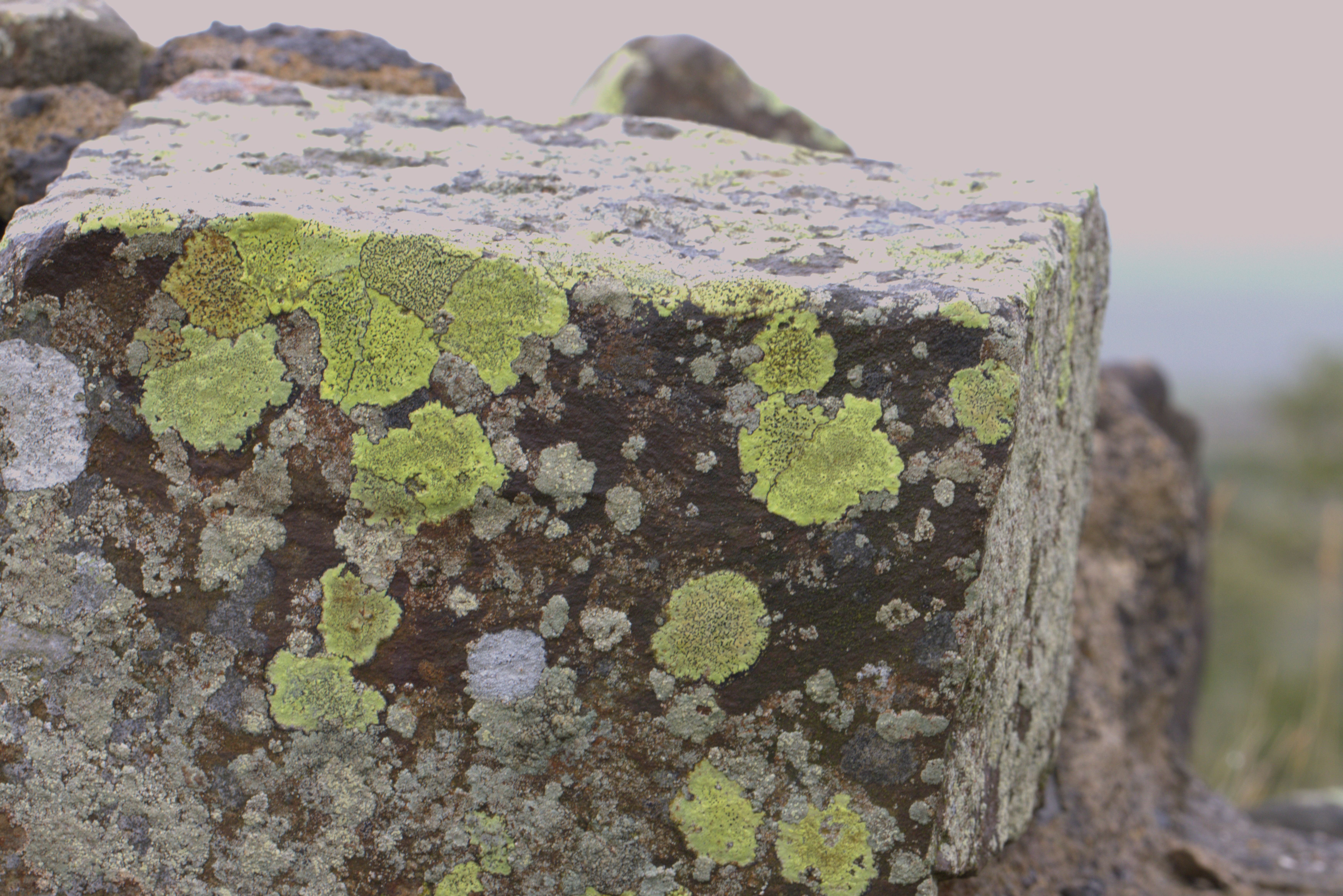
Colonisation probably did not get underway until sometime after 406AD when the Romans withdrew. Even after that date there is evidence that local rulers maintained sections of the wall and some of the forts for anything up to two hundred years. It would in any case have taken time for plaster to fall off and cracks to develop. The first colonisers would be plants dispersed by seeds or spores. Spores blow long distances on the wind and so mosses and lichens would be the first plants to show up, exactly as they do today on gravestones or rock -formed coastal defences. They would have paved the way for subsequent, larger species, as over time they died and got washed into the crevices between the stones so that gradually a type of organic soil would have developed. This would provide not only a source of water but also nutrients for the ferns and flowering plants that came later.
Ferns are also dispersed by spores and so the second wave of colonisation probably had a high proportion of ferns. Plants might also have arrived by way of animals bringing in seeds. Many species of plant produce fruits and nuts in order to attract animals which then either move the fruits and nuts to store them somewhere such as in a wall, or they eat them and the seeds pass through with their droppings and get deposited on the wall whilst the animal is having a rest.

However getting to the wall is just the start. The seedling then has to get established. In the Vallum this might have been quite easy and soon this would have been overgrown with Brambles, Hawthorn, Blackthorn and, probably Gorse. Thereafter trees such as Oak and Beech might have developed although the climate can be is quite cold and bleak so they would have struggled.

On the walls of the forts and along the wall, life would have been tough for the flowering plants. Plants that were already adapted to grow on rock faces and cliffs would have found the walls most suitable. The number of plants back then that could have colonised would have been significantly fewer than today. Well over half the plants that we now find on walls would not have been in the Britain at that time as they have been introduced since then. It is possible that soldiers might have brought a few species with them. Wallflowers are generally thought to have been introduced by the Normans but they do have lots of medicinal uses and conceivably soldiers could have imported them as it has been recorded that Roman soldiers used a poultice of Wallflower leaves to treat wounds. However most of the Roman soldiers stationed on the wall and in Britain generally were not from Italy. Many came from Gaul and two of the brigades that were stationed at the wall were from Tungria , now Belgium, and Batavia on the Rhine delta.

The flowering plants most likely to have colonised the wall would have been species such as Stonecrop, Whitlow Grass, Bittercress and Sandworts. These are all small native species which would not have made much visual impact.
As time went by the wall was gradually plundered to provide stone for other constructions, some of them, such as Hexham Abbey, quite grand, others less so. The B6318, known as the Military road which runs west from Newcastle, was constructed from stone which was removed from the wall and pulverised to provide hardcore.

Nowadays the wall attracts thousands of visitors each year and car tyres and walking boots will bring seeds from all over the world so who knows what could turn up. Getting there is just the start and colonising is the big ask but with climate change anything could grow there in the future. Perhaps there might be orange groves and olives lining the route one day. Very Italian.
Harebell and Milecastle 37, Hadrian’s Wall

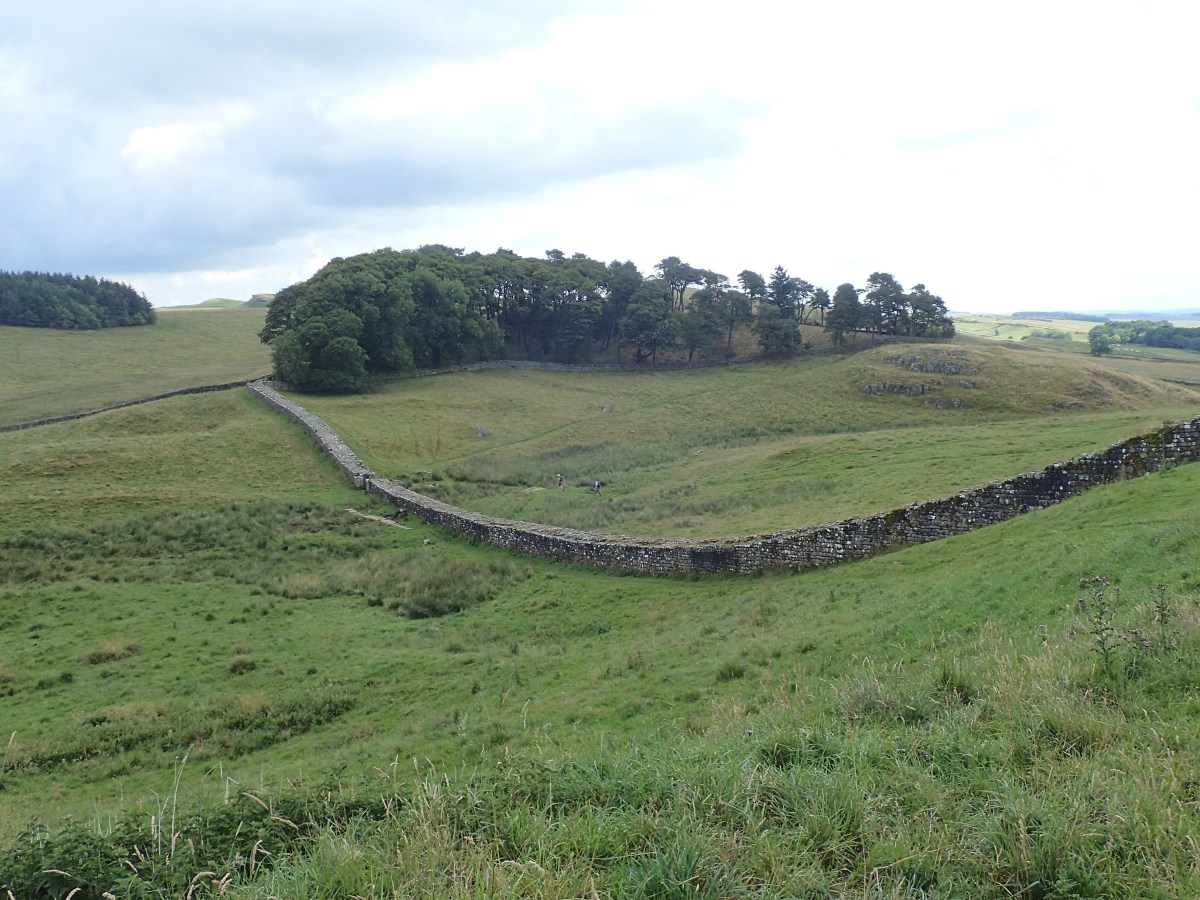
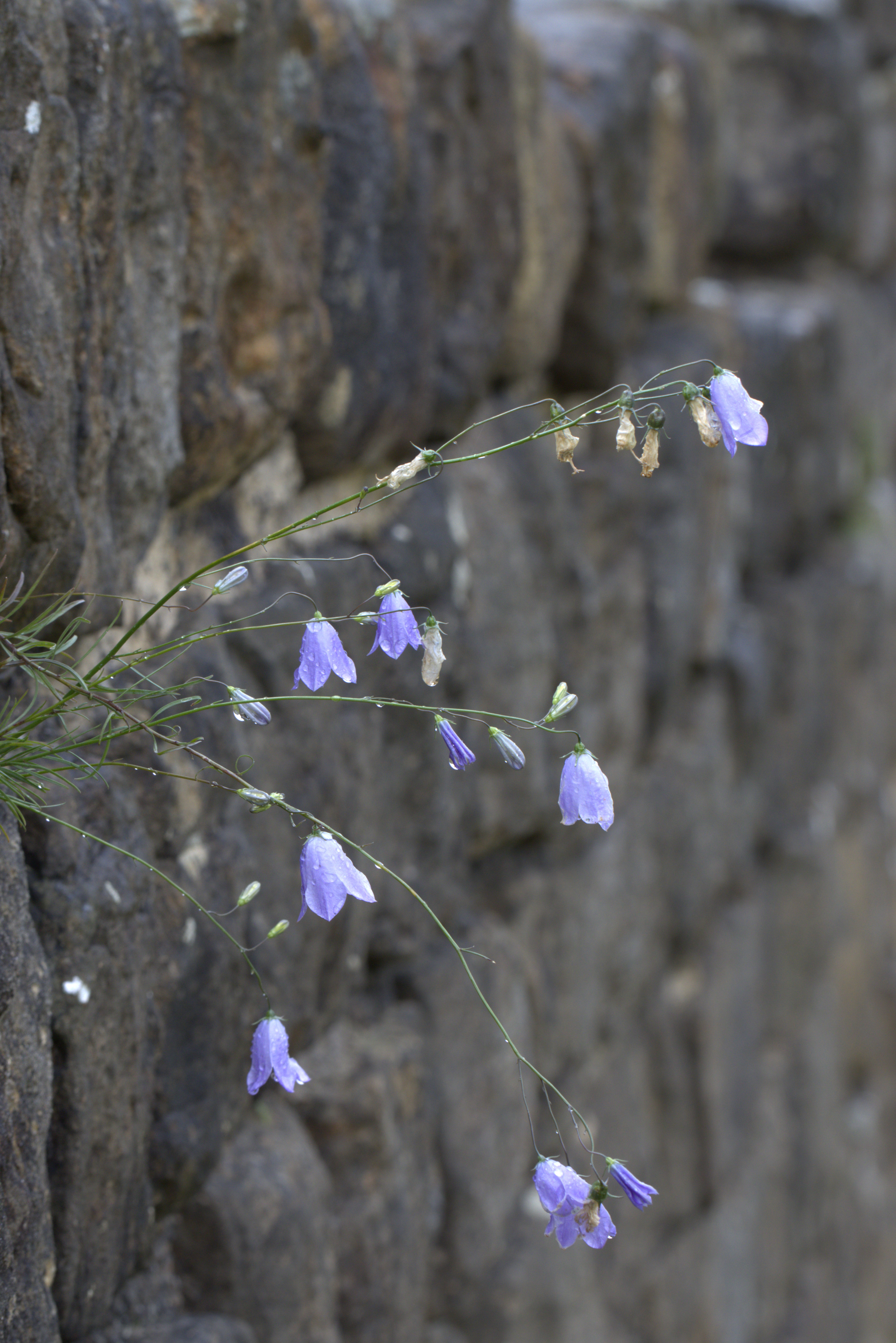
During a recent visit ‘up north’ as a southerner would say, we visited several places along the Hadrian’s Wall and I encountered Harebell numerous times. It was of course growing across the region in the low grassy moorland, but it was also growing directly out of or on top of the wall.

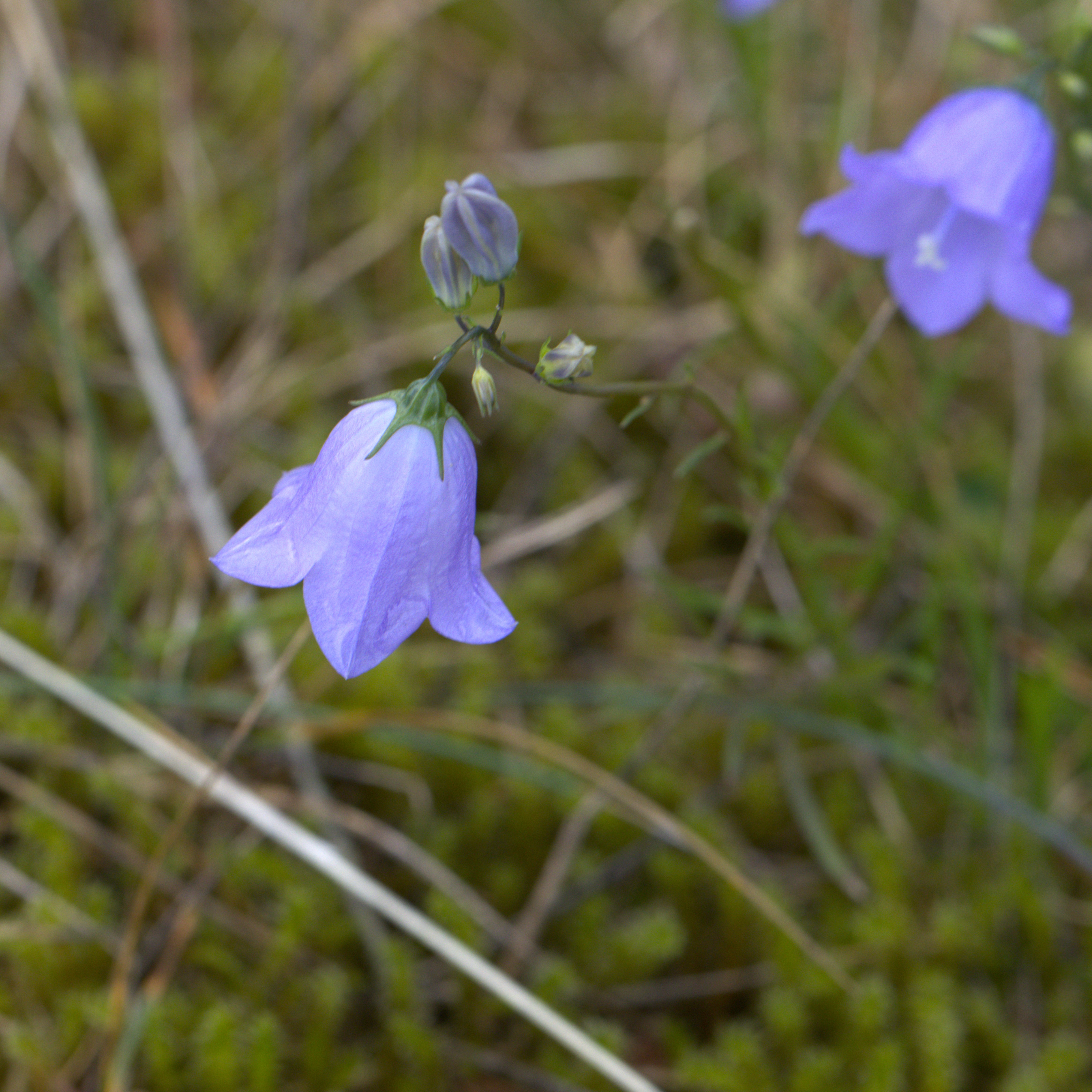
This beautiful and delicate looking little species is a rhizomatous perennial herb. It is however far from delicate in its requirements, being quite tolerant of dry, open, and infertile habitats. It is also not too fussy about soil pH being found in both mildly acidic and alkaline soils also it can tolerate some heavy metal presence. All in all it is well suited to life on walls but is also encountered in grassland, fixed dunes, rock ledges, roadsides and railway banks. It flowers from mid summer onwards.

Its scientific name is Campanula rotundifolia and it has several common names as you might expect, one is Scottish Bluebell but in Scotland they often call it simply Bluebell. It is not related to what the English think of as a Bluebell the one that grows in woodlands. It is the flower emblem of Sweden and the county flower of Yorkshire.

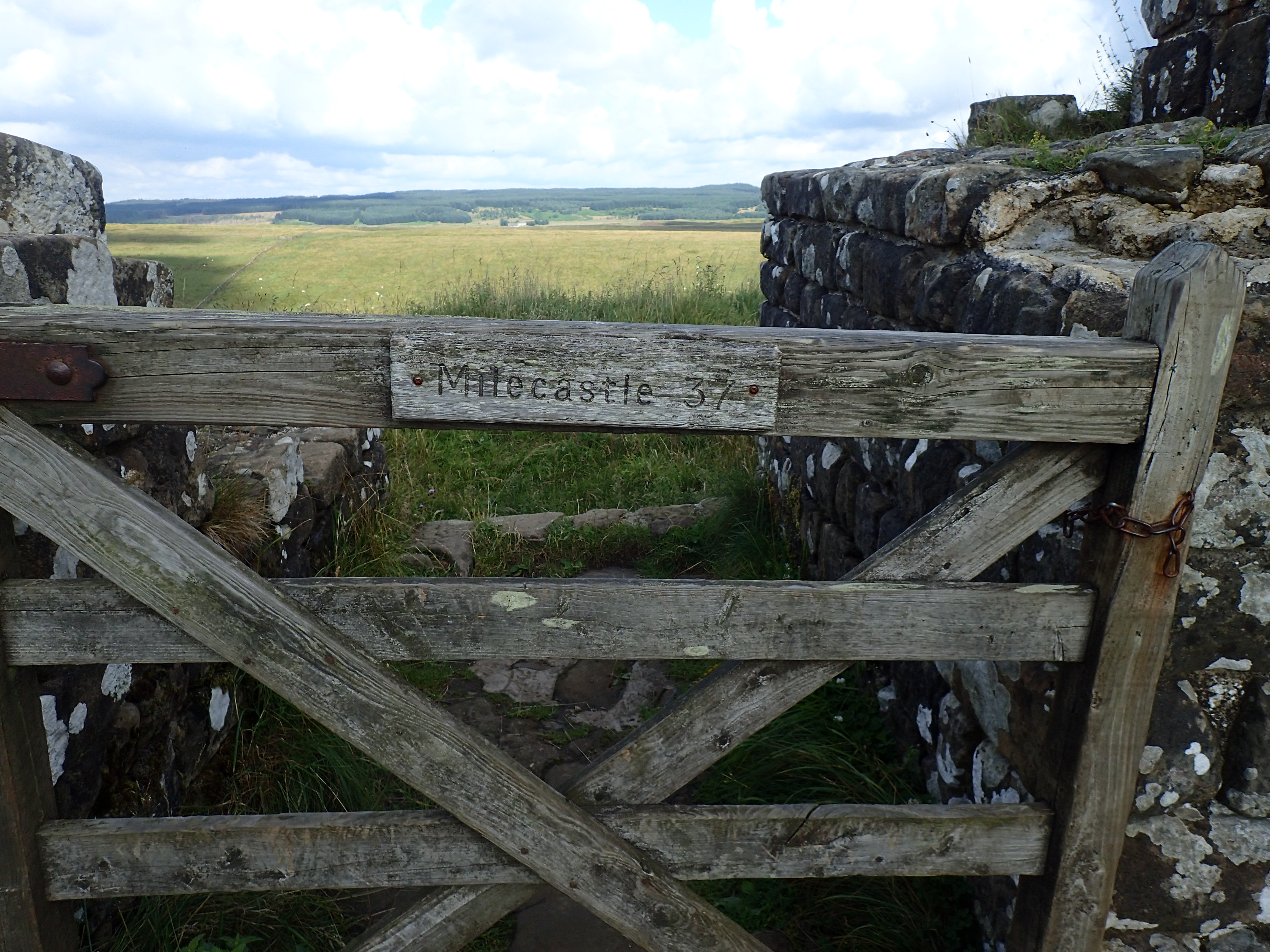
One of the places we saw it on Hadrian’s wall was mile fort number 37. it is the next fort along from Housesteads. Not surprisingly these milecastles (small forts) were built at one mile intervals all the way across the length of the wall.

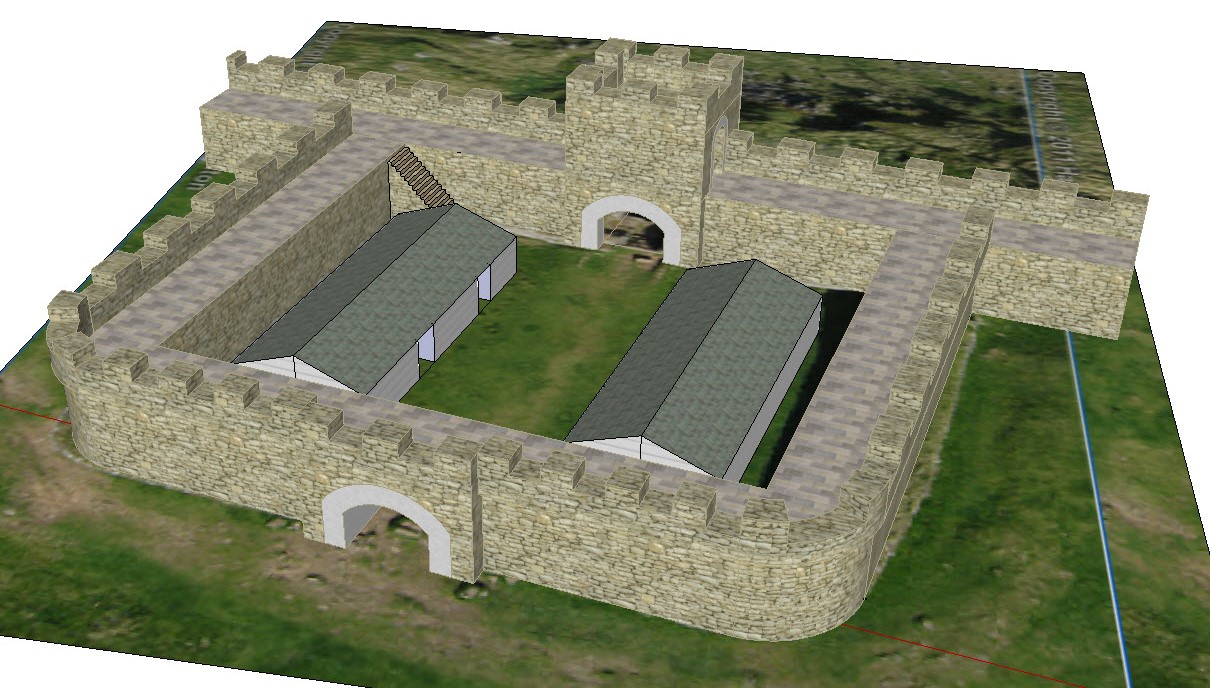
This artists impression of how Milecastle 37 would have looked is by courtesy of HUKBMBEAR Thank you.

When it was up and running it would have had housing for 20 to 30 soldiers and they would have remained on site also each garrison would have manned the neighboring turrets. The milecastle’s garrison was a border post as well as being defensive in time of rebellion. It would have allowed the passage of people, goods and livestock across the frontier, and it is likely that the milecastle acted as a customs post to levy taxation on that traffic. Could Scottish independence could see the reintroduction of modern day equivalents?

Between each milecastle there would have been two turret structures these were located approximately one-third and two-thirds of the way between the milecastles; all very neat and precise just like the Roman roads.

The two turrets linked to milecastle 37 are named 37a and 37b. 37a is at Rapishaw Gap and was probably demolished before the Romans abandoned the wall and the only evidence for it now is some earthworks which can only be appreciated from aerial photographs.

Turret 37 b at Hotbank Grag is still visible but it is just a stone studded earthen platform so not that impressive now.

 There were 80 milecastles and 158 turrets.

Hart’s-tongue Fern and Hadrian’s Wall

I finally got to visit Hadrian’s Wall about 50 years after I purchased the Ordnance Survey map of the area, back then it cost me 55p and in the bottom corner it has Crown Copyright, 1964. I suspect that I purchased it around 1973, at that time I was quite into ancient history. Apart from reading quite a lot of history books I remember visiting Stonehenge, back then it was free and you could walk right up to it and touch the stones, not so now.

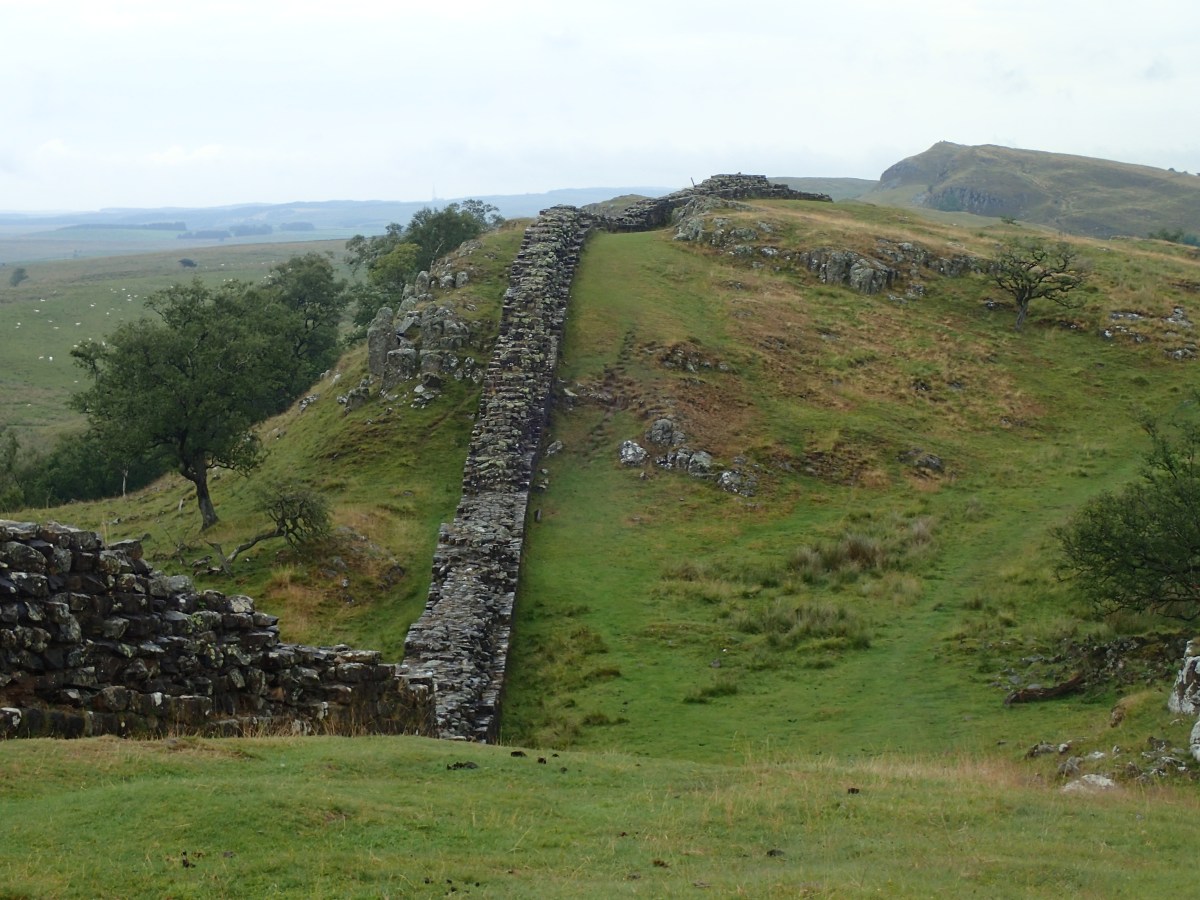
We spent two days at various sites along the wall, working our way from East to West. The scenery is quite magnificent and there are lots of places where you can see the wall stretched out across the countryside and I suspect a Roman legionnaire would still recognise the scene if he could be magicked back into exitance today. The region near Walton Ridge was quite evocative and one of the plants growing there was the Harebell which is the subject of another chapter.

We came across the Hart’s-tongue fern at Vinolanda, and it was the only place where I saw it and even there I only spotted a couple of specimens. Vinolanda is a Roman auxiliary or supply fort about half way along the course of the wall. When the wall was built it had look out turrets every mile, then every so often there were large garrison forts set just back back from the wall, there were also forward forts these were located a little distance Infront of the wall and then supply forts located some distance behind the wall.. At its height there would have been about 10,000 soldiers distributed along the 73 mile wall and add to that there would have been large numbers of civilians, traders and entertainers and all the support folk that a large body of men would have attracted! If you take my meaning.

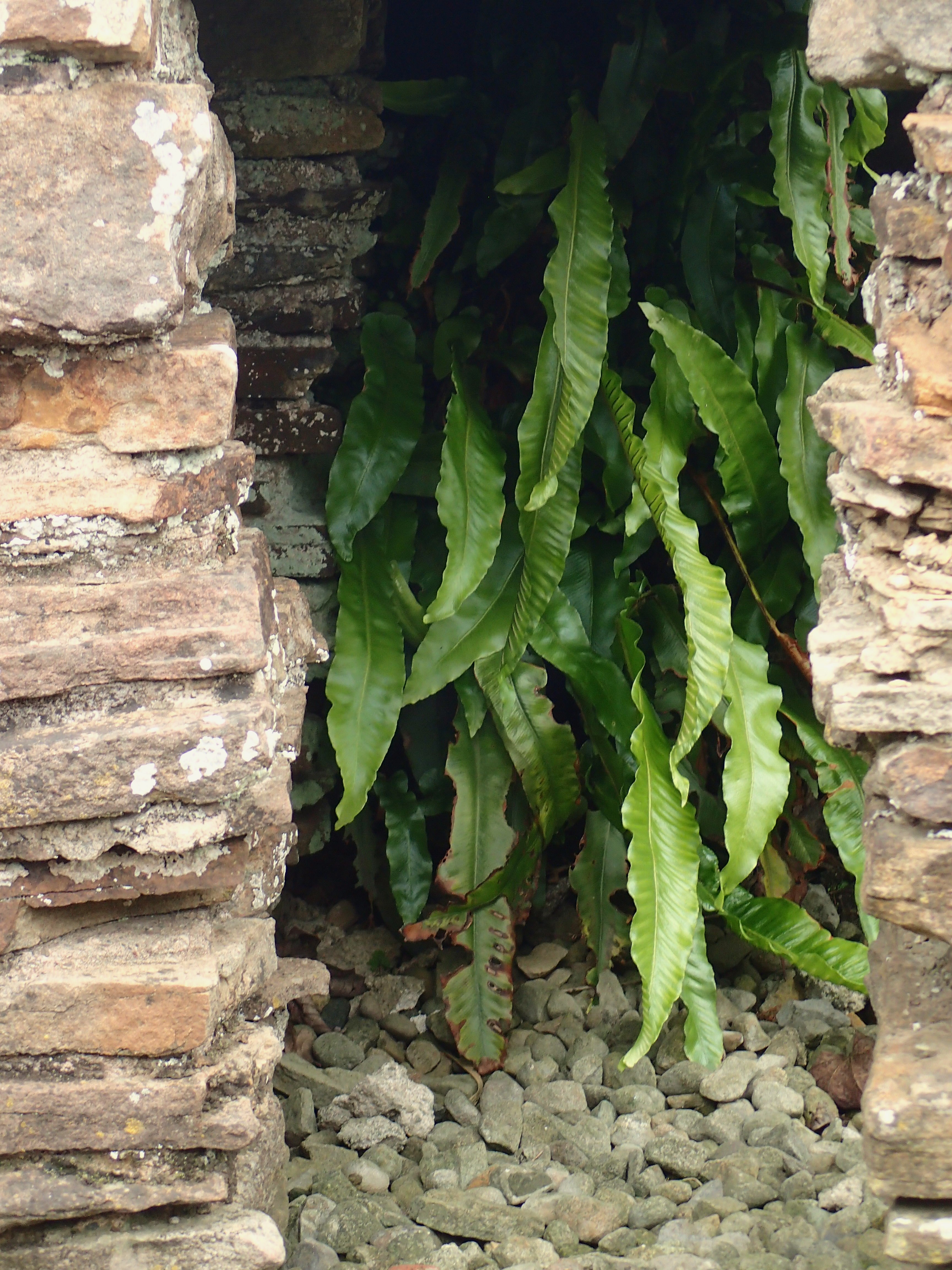
During the course of the Roman occupation the construction of the forts changed and older buildings were abandoned and new ones constructed. An example is that at Vindolanda there are two bath houses an earlier one constructed around 103 to 105 AD and a later one dating to the 3rd or 4th century AD. This bath house is located outside the main fort as were numerous other buildings housing the extensive community associated with the military camp. The bath would have been used by both soldiers and civilians but probably at different times. The reason it was outside the main fort was because of the risk of fire. Bath houses were heated by furnaces and hot air was ducted underneath raised floors called a hypocaust, this floor is about 80cm above the ground, the space underneath is now providing a home for the fern, I doubt much would have survived there when hot air was being circulated. The floors themselves got quite hot and bathers would wear thick wooden clogs to prevent burning their feet.

Apart from all the stone remains there is a superb museum at Vinolanda with some amazing finds that aerologists have recovered from the site. The shoe and sandal collection is the first thing you see as you enter, the coins, jewellery and glass wear is stunning but perhaps the most amazing finds are small wooden tablets with writing on, lots of them, and they have been translated and they are what folks back then were saying to one another it is the emails of the time.

I cant resist giving you a flavour of what they cover this one, randomly selected, (there are hundreds of them) was translated as saying.

bruised beans, two modii, chickens, twenty, a hundred apples, if you can find nice ones, a hundred or two hundred eggs, if they are for sale there at a fair price. … 8 sextarii of fish-sauce … a modius of olives … (Back) To … slave (?) of Verecundus.”

A shopping list! and they cover a vast range of subjects anything that one person might write to someone else.

I could go on about the museum and all its contents for much longer but lets switch now to the Hart’s-tongue fern which here was sheltered and protected by growing in the wall of the old underfloor heating. Protected not only from the elements but possibly also from the herbicide sprays that are no doubt occasionally used to keep the walls reasonably weed free. Hart’s-tongue fern is one of the few or only British ferns which has an entire leaf, ie not divided into lots of smaller leaves and leaflets, the typical compound leaf that ferns and some higher plants like Cow Parsley have. The Adders tongue fern has a small rolled up leaf somewhat similar to the spathe on a Lords and Ladies plant so that is the only other British fern with an entire leaf. On the undersides are the distinctive spore producing areas (sori) which turn brown as the spores are produced. This species retains its leaves during the winter but then produces a new batch in the Spring and the old ones gradually die off over the summer.

The scientific name is Asplenium scolopendrium but it is also called Phyllitis scolopendrium. The BSBI (Botanical society of Britain and Ireland) call it Phyllitis so that’s the one I would go for. It is found all over the UK and Ireland and often grows from walls or rocky outcrops, its only restriction on distribution is that it does not like acidic conditions. The species name ‘scolopendriun’ derives from the arrangement of millipedes or centipedes feet as the pattern of the sori on the underside resembles these species.