There are two bridges over the river Wharfe in Ilkley and the ‘Old Bridge’ and the ‘New Bridge’ The old one dates back to the 1620’s but that original one got washed away in 1673 and the present ‘Old Bridge’ was constructed in 1675. So it is quite old and consists of two spans and is quite narrow as it was designed to carry pack horses and people not cars.
It did get used for vehicles once they had been invented but that was banned in 1948 so now it is just people and bicycles and I suppose a pack horse would still be allowed to pass across. 
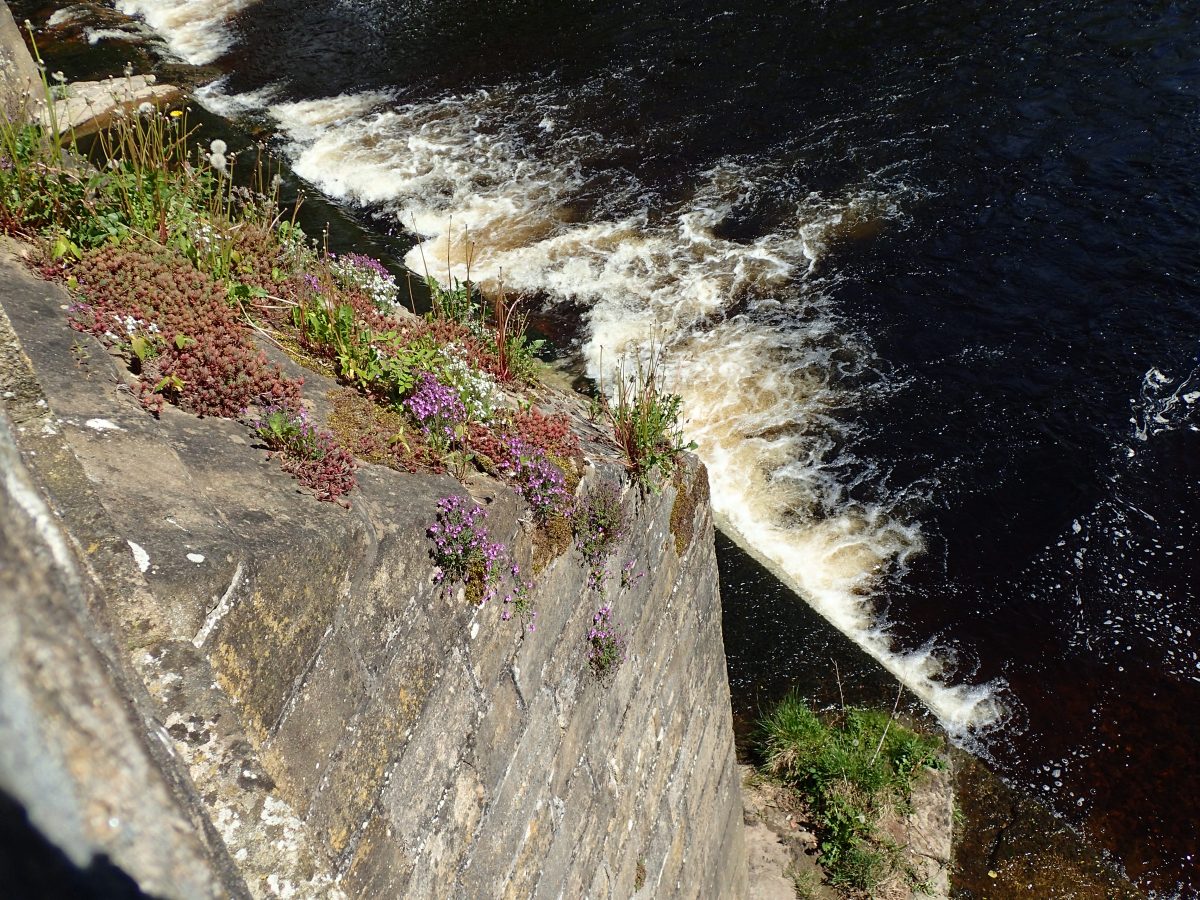
The Fairy Foxglove is growing on one of the buttresses that support the bridge along with several other species, including House Leeks. The foxglove was in flower in May when I visited. As the buttress is well below the road level it was difficult to get a close up of the plant, I am not much into abseiling.
This plant is not native it is described as naturalised, ie it was introduced into gardens and then got established in the countryside. Originally it is a mountain species coming from southern Europe and north Africa. It was first brought to the UK in 1793 and was first recorded growing in the wild in 1867. However there is a tale that it was brought to Britain by Roman soldiers who had to cross the Alps to get to us and picked up some seeds on their boots. Just a tale as most ‘Roman’ soldiers in Britain did not come from Italy. However the story gets a bit of a boost as Fairy Flax does grow on Hadrian’s Wall and in the village of Wall which is close to Hadrian’s Wall.
Its distribution is mostly Northern England and Southern Scotland but it does occur in the south and in Wales, I suppose if folks are growing it in their gardens then it can escape to any part of the UK, just that it seems to survive better in Northern climes, no doubt reflecting its mountainous origins. I saw lots of it growing on walls of buildings at the top of the hill going up to Stirling Castle in Scotland.
The plant is a perennial and low growing with fleshy and hairy leaves that form a roughly basal rosette. The flower are pink and composed of five bilobed petals that fuse together at the base. However the petals are not all the same size, the two that point upwards are smaller and the three pointing down are larger and if anything the central one of the three is slightly bigger still. This is known as zygomorphic.
Its scientific name is Erinus alpinus which reflects its origin, it also has several common names like Alpine Balsam
 Walls and Flowers