In the same way as plants come to have wall in their name, there are several animals which have become so associated with walls that their name actually includes the word wall. Of course there are a few like a wallaby and, at a pinch, a walrus, that have wall as part of their name but have nothing to do with walls. I have limited the list, which is not very long anyway, to species that occur in the UK and several of these have only rarely been seen. . I have included Mason Bees as masonry and walls are essentially the same thing.
Starting with the most advanced and working backwards there is the bird the Wall Creeper. I have not been able to find any mammals with wall in their name. Wall Creepers (Trichodrroma muraria) are similar in habit and shape to Tree Creepers but they are somewhat larger, about the size of a Blackbird, they have some wing feathers which are bright pink and they live on walls not trees. They are widely distributed across Europe and Asia but tend to be associated with mountainous regions such as the Alps and the Pyrenees. During the winter they do descend to lower levels and have occasinally found their way to Great Britain. 
Photo above from Nature Travel Birding, who take trips to where they live.
There are just ten records of it being seen in Britain, the first dating from way back in 1792 when it turned up at Stratton Hall in Norfolk. The most recent sighting was in 1985 when one made it to the Isle of Wight. I have never seen this bird although I spent some time looking for it in the Parco Nazionale dello Stelvio in the Italian Alps. One did turn up in Poitiers some years ago and spent time on the cathedral in the centre of the city but unfortunately I was not in France at that time.
Next there is the Wall Lizard, (Podarcis muralis). This is not a native of mainland Britain although it has been recorded in a variety of places and has managed to establish itself in a few locations particularly on the south coast. There are over two thousand records of sightings in Britain. It is native to the Channel Islands. We have them around our house in France. The house is made of a traditional construction of large stones and mud based mortar so it is home for many creatures and Wall lizards are always about. 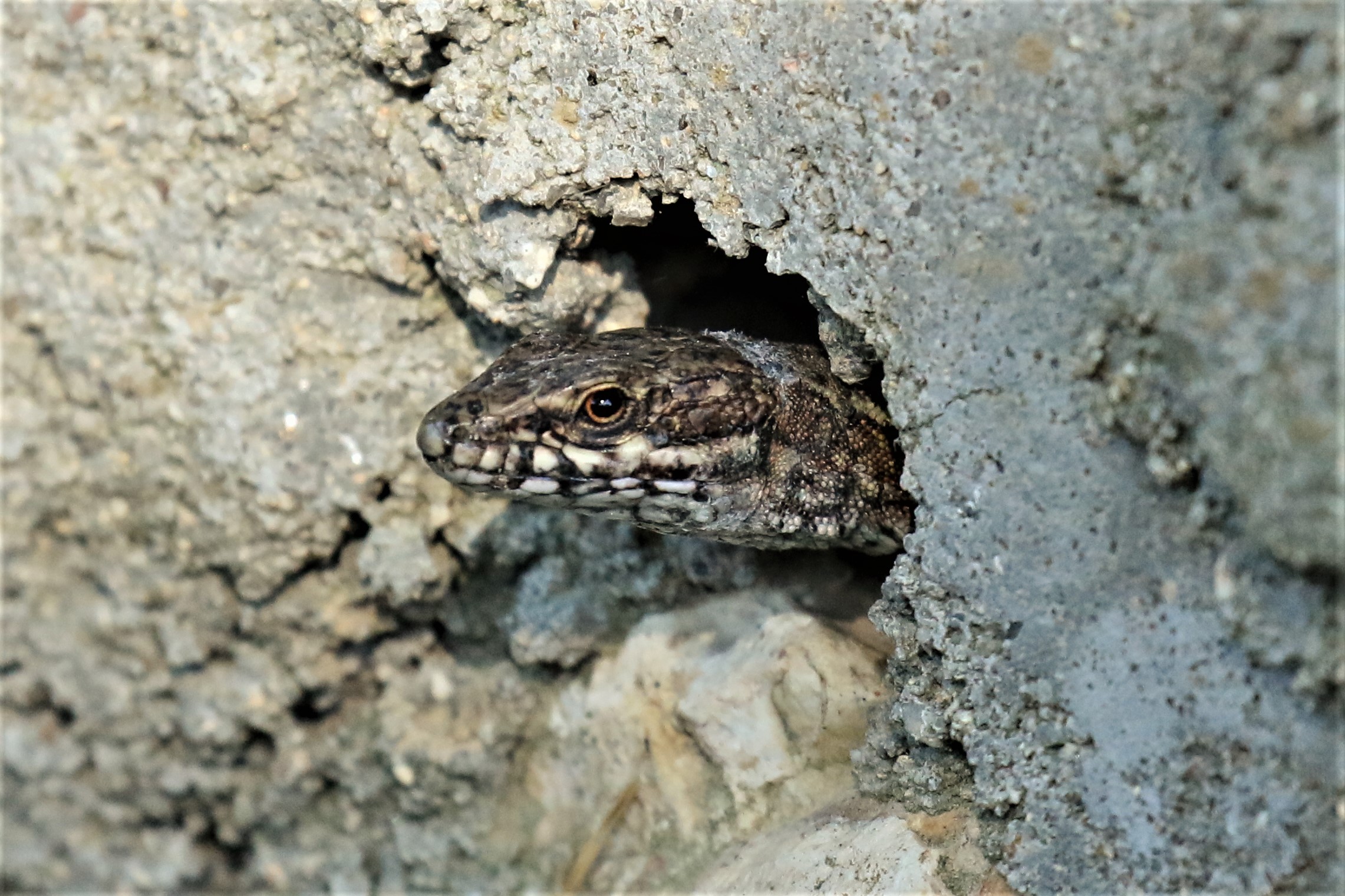 0
0
Interestingly there are six different morphs of this species based on colour so there is, amongst others, a green morph, a red morph and a white morph. However the differences between them extend beyond just their colour. For example the yellow morph produces more eggs but they are small and the white morph produces fewer but larger eggs. This is seen as an adaptation to climatic conditions. Where the climate is more favourable the species can risk producing more offspring but when it is less so it is better to produce fewer but bigger youngsters which may survive more easily.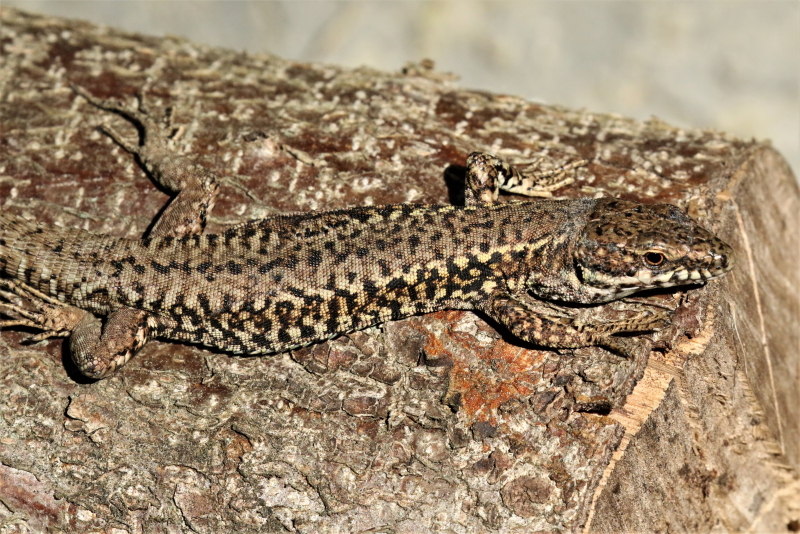
Other variations between the morphs include their resistance to different diseases and the types of pheromones that the males produce to attract females.
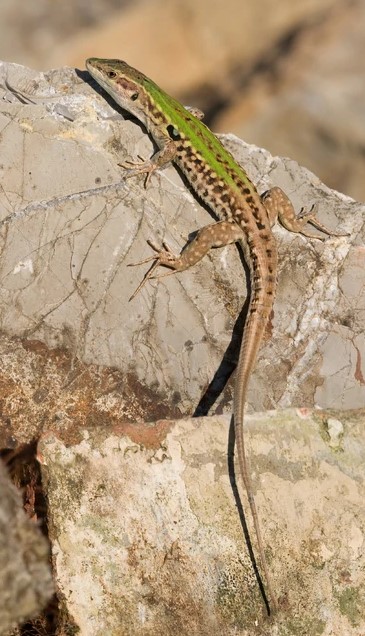
There is a related species called the Italian Wall Lizard which lives in the Britain and there is an established colony in Dorset. A small number were accidentally introduced into Buckinghamshire when they were imported with a consignment of Italian tufa stone. They were all captured to prevent the spread of another alien species.
 Turning to the invertebrates, there is a butterfly called simply the Wall, or sometimes a Wall Brown (Pararge megera).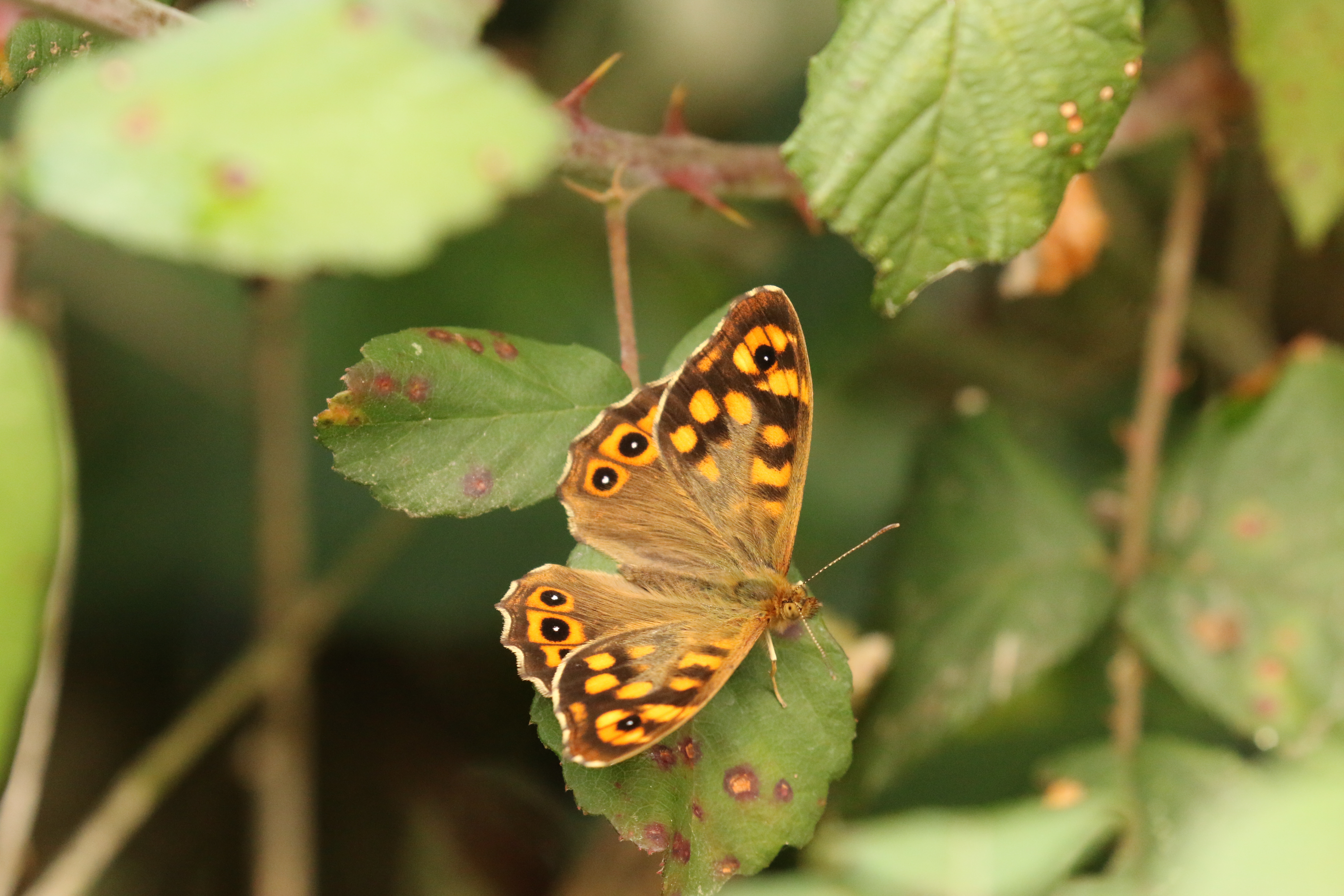
This was fairly common when I was a boy, but I see it less often now, possibly because I grew up in Essex and now live in Gloucestershire, or maybe because there has been a general decline in butterfly numbers. This species, more than most, seems to love to sun itself so will seek out places to bask and walls provide it with that facility. It will also make use of sunny hedge banks, tree trunks and gravel pits, in fact anywhere sunny and warm. Its caterpillar feeds on various coarser grasses such as Couch Grass and Cocksfoot. The caterpillar overwinters and so needs to find somewhere sheltered and predator proof to survive from November to March when it will turn into a chrysalis just briefly before hatching out in early May. There will be two or maybe three broods in a year so the numbers of adults will increase later in the summer.
There is a large group of spiders called Wall Spiders but only one of these has been found in Great Britain and even then very rarely. They are generally found in warmer countries. Today as I write this temperatures are set to reach 40 degrees in some parts of the UK, a new record, so maybe the Wall Spider will start to turn up more frequently. The species which has been recorded in the Britain is Oecobius navus and it has only been seen three times. 
It is not that impressive in terms of size being only 2.2 to 2.5 millimetres long, but it does have some interesting features. It makes a small particularly fine pad of web in a crevice in a wall. It has an organ called a cribellum through which its thread of web passes and this splits the already fine thread into multiple smaller threads, which serve to entrap small insects. When an insect gets caught the spider bites it thereby introducing sufficient poison to paralyse it so that the spider can then eat it at its leisure. It will also run round and round its prey at the same time as producing these very fine threads and thus further deactivate it.
Finally in terms of animals with wall in their name there is a small spire shaped snail called a Wall Snail Balea perversa, also known as the or tree snail. I have them in my garden wall. They appear during damp conditions and today they will be hiding deep inside the crevices to avoid the heat. They feed on algae and lichens which grow on the surface of the rocks that make up the wall. They are small, less than 10 millimetres in length but they are beautifully constructed with a fine spire shape. 
Mason Bees frequent walls and again my French house is home to many of them which is not ideal as they excavate little tunnels in the mud mortar that holds the walls together. The Osmia genus is the main group of bees excavating holes in walls and there are several in Britain the commonest of which is probably the Red Mason Bee (Osmia rufa). Its scientific name gives a better description of its colour which is not red but decidedly ginger.
There is also Osmia coerulscens , the Blue Mason bee. It is actuallygrey, maybe steel blue at a pinch.
There are many other species which make good use of walls including certain molluscs, woodlice and springtails but I have not found any with wall in their name. There are Plaster beetles and mites which occur on newly plastered or damp walls where they feed on fungus growing on the damp plaster.












 Walls and Flowers