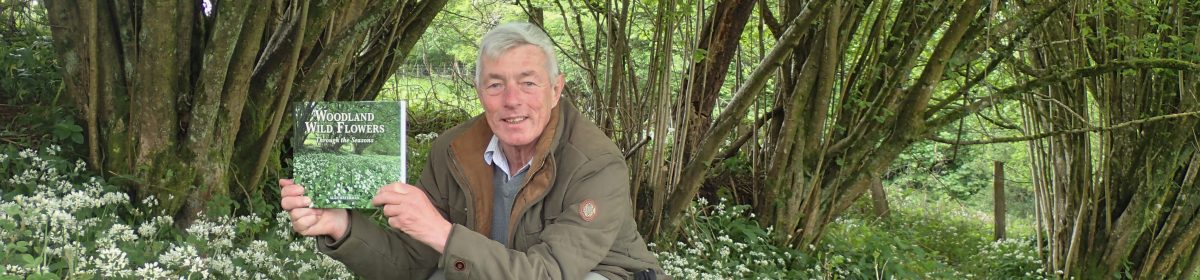

Climbing Corydalis is a delicate little plant it is sort of an annual but it can live longer than a year and often germinates in late Autumn and I have seen it flowering during the winter so it is a bit ‘all over the place’ which also describes its way of growing. It spreads and can climb but it needs help, by the watch tower it is sort of extending up the sides but it is not an out and out climber. It has compound leaves which do have little tendrils on the ends but they are not that strong. The flowers are small and creamy white, it is related closely to the fumitories and has a similar almost pea shaped flower. It grows in shaded woodland and is often found on walls that are shady and surrounding woodland, There is a lot of it in places along the tops of the walls at Ninewells wood but it also grows on the woodland floor especially if there is no competing taller vegetation like Bracken. There is more about Climbing Corydalis in my book Woodland Wild Flowers. 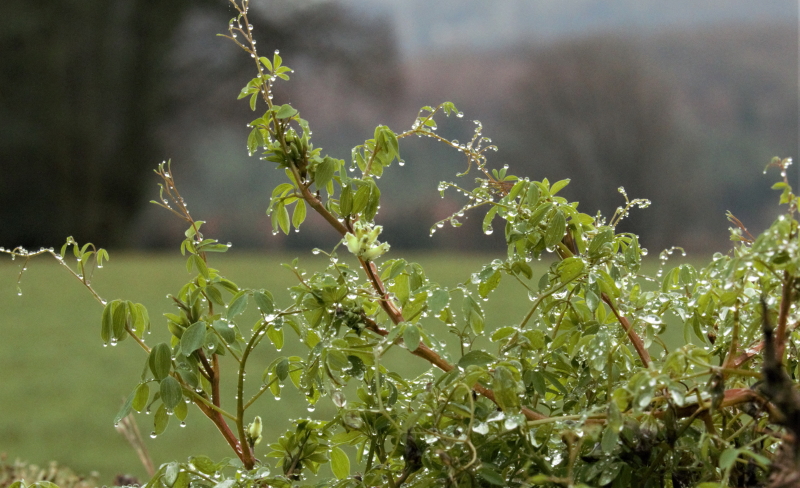
Surrounding parts of Ninewells wood in Monmouthshire there is a substantial wall and located at the top corner looking out towards the Bristol Channel and the Severn Bridges there is a small circular tower.
Now some say these walls and the tower were constructed by Napoleonic prisoners of war and others say it was Italian PoW’s from the second world war. However, I have not been able to find any hard evidence for either possibility. What I have found is that there were Napoleonic PoW’s in Abergavenny and that is the nearest place to Ninewells wood that I have found. Abergavenny is some distance away and given that transport was not very speedy back then, it makes me think that the Napoleonic connection is somewhat tenuous. On the other hand there were a lot of second world war PoW camps in the area. There was one at Chepstow at a camp called the Mount and that had 197 occupants. Also there were 3 camps in Abergavenny, Claremont housing 29, Mardy housing 118 and Llanover Park Camp housing 200 and of course transporting men from further afield was more possible in the 1940’s. I do not know if the PoW’s were Italian or maybe German. 
The story is that the tower was constructed so that an overseer could keep watch on the prisoners as they constructed the other walls which mark out the fields to the south and west of Ninewells wood. The walls are certainly well constructed and quite thick, they do have some trees growing out of them
Paul Chamberlain, author of ‘Hell Upon Water: Prisoners of War in Britain 1793-1815’ said: “The French Revolutionary and Napoleonic Wars represented something of a watershed for European combat, as they were the first major conflicts during which large numbers of surrendering troops were taken prisoner rather than slaughtered.
“From 1793 until 1814, over 200,000 French and French allies were held as PoWs, and whilst it’s impossible to put a definite figure on it, several thousand of them would have been held in Wales.
“But the story that they built some of the walls in the area is a local myth, as PoWs were not used on construction projects as it took work away from the civilian workforce.”
There is a good web site about The walls of the Wye Valley and in this it is suggested that the walls near Ninewells wood may be the work of Monks from Tintern Abbey. The stones used in the construction of the walls and tower are all faced and the ones in the tower have a curved exterior which would have taken some time and skill to produce. The question is why was the tower constructed if it was not a watch tower to oversee prisoners? Could it have been used as a beacon for a fire to light up and transmit a messages regarding an invasion? It is located in a position where it could be seen from a long way off..
There are quite a few references to walls being constructed by prisoners of war but it is all conjecture based on earlier references and I have not found any firm evidence. What I can say is that the walls and the tower are very well constructed and apart from some damage to the tower, the walls are in good condition suggesting either a high degree of maintenance or that they are not that old. Also there are some trees growing close to or out of the wall however none look to be more than 50 years old. Also the number of species growing on the walls and tower are not that extensive. There are a few grasses and Polypody Fern, some Sorrel and Climbing Corydalis.

 Walls and Flowers
One thought on “Climbing Corydalis and The Watch Tower Ninewells Wood”